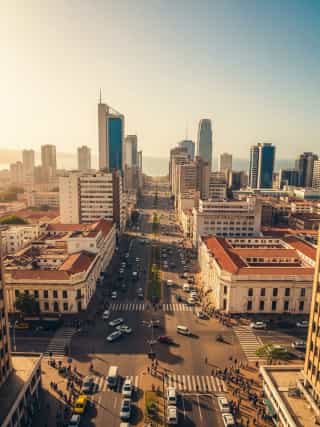
Luanda - The Capital of Angola
- Population
- 8,330,047
- Language
- Portuguese
- Continent
- Africa
- Since
- 1575
- Eco Ranking
- 124/195
Source: Environmental Performance Index 2024.
About Luanda
Luanda was founded in 1575 by Portuguese explorer Paulo Dias de Novais, making it one of the oldest European colonial cities in sub-Saharan Africa. For nearly three centuries it functioned as a major hub of the transatlantic slave trade, with estimates suggesting that between 3 and 4 million enslaved Africans were shipped from Luanda to Brazil and the Caribbean. Angola gained independence from Portugal on 11 November 1975, but independence was immediately followed by a civil war between the MPLA (People's Movement for the Liberation of Angola), backed by the Soviet Union and Cuba, and UNITA, backed by South Africa and the United States. The civil war lasted until 2002, one of Africa's longest and most destructive conflicts. The MPLA has governed Angola without interruption since 1975. Luanda served as the political and military headquarters of the MPLA throughout both the independence struggle and the civil war. Today it is a heavily centralized capital where government, oil revenues, and economic power are concentrated. Despite Angola's vast oil wealth, Luanda has one of the most extreme wealth disparities of any African capital.
About Angola
Angola is a large Central African state on the Atlantic coast, bordered by the Democratic Republic of the Congo, Zambia, and Namibia. It gained independence from Portugal in 1975 after a protracted liberation war. The MPLA has governed continuously since independence, initially as a Marxist-Leninist party and later transforming into a ruling party in a nominally multiparty state. Angola is one of Africa's largest oil producers. The civil war between the MPLA and UNITA ended with the death of UNITA leader Jonas Savimbi in 2002.
View Luanda on the map
Flight time from Luanda to other capitals
| City | Distance (km) | Flight Time |
|---|---|---|
| Cape Town | 2800 | 3h 18m |
| Rome | 5600 | 6h 35m |
| Abu Dhabi | 5800 | 6h 49m |
| Paris | 6500 | 7h 39m |
| London | 6800 | 8h 0m |
| Buenos Aires | 7800 | 9h 11m |
| Singapore | 10100 | 11h 53m |
| Washington, D.C. | 10600 | 12h 28m |
| Canberra | 13300 | 15h 39m |
| Tokyo | 13800 | 16h 14m |
Capitals with similar population to Luanda
Capitals with similar eco ranking to Luanda
| City | Eco Rank |
|---|---|
| Ashgabat | 120 |
| Baku | 121 |
| Nuku'alofa | 123 |
| Tegucigalpa | 124 |
| Luanda | 124 |
| Niamey | 126 |
| Beirut | 128 |
Source: Environmental Performance Index 2024.
Frequently Asked Questions
When did Luanda become the capital of Angola?
Luanda became the capital of independent Angola on 11 November 1975. It had previously been the capital of Portuguese Angola, serving as the colonial administrative center since the late 16th century. Independence was declared by the MPLA, whose forces controlled Luanda at the time, while rival movements controlled other parts of the country.
What was Luanda's role in the transatlantic slave trade?
Luanda was one of the principal ports of the transatlantic slave trade from the late 16th to the mid-19th century. Historians estimate that between 3 and 4 million enslaved Africans were shipped from the port of Luanda to Brazil and other parts of the Americas, the largest volume from any single port in African history.
How long did Angola's civil war last?
Angola's civil war lasted from 1975, the year of independence, to 2002, 27 years. It was fought primarily between the MPLA government based in Luanda and UNITA led by Jonas Savimbi. The war ended following Savimbi's death in combat in February 2002. It is estimated to have caused over 500,000 deaths and displaced millions.
Is Luanda the largest city in Angola?
Yes, Luanda is Angola's largest city by a significant margin. The city's population grew dramatically during and after the civil war as internally displaced people moved to the capital for safety. Current estimates put the metropolitan area population at over 8 million, a dramatic growth from a few hundred thousand at independence in 1975.
Who has governed Angola and Luanda since independence?
The MPLA (Movimento Popular de Libertação de Angola) has governed Angola without interruption since independence in 1975. José Eduardo dos Santos served as president from 1979 to 2017, one of the longest presidential tenures in African history. João Lourenço succeeded him and introduced anti-corruption measures targeting dos Santos family members.
Sights and landmarks
Climate and best time to visit
Economy