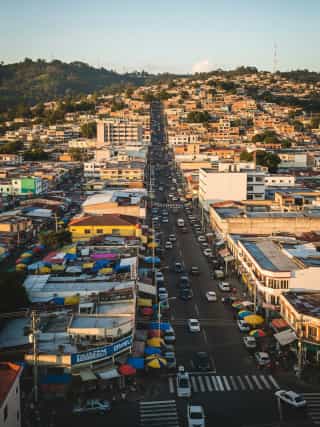
Tegucigalpa - The Capital of Honduras
- Population
- 1,363,000
- Language
- Spanish
- Continent
- North America
- Since
- 1578
- Eco Ranking
- 124/195
Source: Environmental Performance Index 2024.
About Tegucigalpa
Tegucigalpa became Honduras's permanent capital in 1880, ending a long period in which the capital alternated between it and the nearby city of Comayagua. Founded as a silver and gold mining settlement in 1578, it grew under Spanish colonial administration. Its name is believed to derive from a Nahuatl phrase roughly meaning 'silver hills'. The city sits in a mountainous valley at around 1,000 metres elevation, which has constrained its physical expansion and contributed to persistent infrastructure challenges. Honduras's political history has been characterised by chronic instability, military intervention, and institutional weakness. A 2009 military coup removed President Manuel Zelaya from office, the first coup in Central America in decades, after the Supreme Court and military objected to his proposed constitutional referendum. Zelaya was flown out of the country in his pyjamas. The coup provoked international condemnation and Honduras was temporarily suspended from the Organisation of American States. The country has also struggled with extreme gang violence, with MS-13 and Barrio 18 operating across Tegucigalpa and other cities, at times giving Honduras one of the world's highest homicide rates. President Xiomara Castro, who took office in 2022, and is the wife of the ousted Zelaya, declared a state of emergency over gang violence. Tegucigalpa is also notable as one of the few national capitals without a railway connection.
About Honduras
Honduras is a presidential republic. It has experienced significant political volatility, including military coups, electoral disputes, and prolonged gang violence that has driven mass emigration. Honduras is among the poorest countries in Central America, with high inequality and dependence on remittances. The country has historically been within the U.S. sphere of influence and has hosted U.S. military bases.
View Tegucigalpa on the map
Flight time from Tegucigalpa to other capitals
| City | Distance (km) | Flight Time |
|---|---|---|
| Washington, D.C. | 2900 | 3h 25m |
| Buenos Aires | 6200 | 7h 18m |
| London | 8600 | 10h 7m |
| Paris | 8800 | 10h 21m |
| Rome | 9700 | 11h 25m |
| Cape Town | 12300 | 14h 28m |
| Tokyo | 12600 | 14h 49m |
| Canberra | 13900 | 16h 21m |
| Abu Dhabi | 14000 | 16h 28m |
| Singapore | 17900 | 21h 4m |
Capitals with similar population to Tegucigalpa
Capitals with similar eco ranking to Tegucigalpa
Source: Environmental Performance Index 2024.
Frequently Asked Questions
When did Tegucigalpa become the capital of Honduras?
Tegucigalpa was designated the permanent capital of Honduras in 1880, under President Marco Aurelio Soto. Before that, the capital had alternated between Tegucigalpa and Comayagua since independence. The city had existed as a mining settlement since 1578 but did not become a stable capital until the late 19th century.
What happened in the 2009 Honduran coup?
In June 2009, President Manuel Zelaya was arrested by the military and expelled from the country, following a Supreme Court ruling that his proposed referendum on constitutional change was illegal. The coup was widely condemned internationally, and Honduras was suspended from the Organisation of American States. Roberto Micheletti assumed the presidency, and Porfirio Lobo won subsequent elections in November 2009.
Why does Tegucigalpa have no railway?
Tegucigalpa's mountainous terrain made railway construction prohibitively difficult during the colonial and early independence period. Unlike Honduras's Caribbean coast, which was developed by banana companies with their own rail networks, the capital's geography isolated it from rail infrastructure. It remains one of the few national capitals in the world with no railway connection.
What is the gang violence situation in Tegucigalpa?
Tegucigalpa has been significantly affected by gang violence from MS-13 (Mara Salvatrucha) and Barrio 18, which emerged from Central American migrant communities in the United States and expanded into Honduras. At its peak in the early 2010s, Honduras recorded one of the highest homicide rates in the world. President Xiomara Castro declared a state of emergency in 2022, suspending certain constitutional rights to combat gang activity.
Is Tegucigalpa the largest city in Honduras?
Tegucigalpa is the largest city in Honduras, with a metropolitan population of approximately 1.4 million. San Pedro Sula, the country's second-largest city in the northwest, is the main industrial and economic hub. San Pedro Sula has historically recorded some of the world's highest homicide rates and is also significantly affected by gang violence.
Sights and landmarks
Climate and best time to visit
Culture and customs