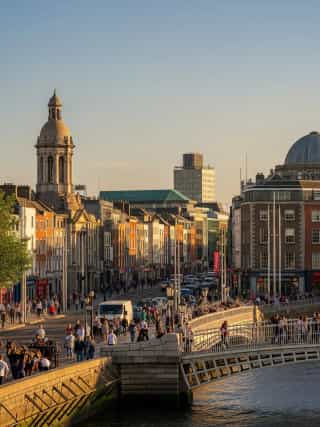
Dublin - The Capital of Ireland
- Population
- 1,388,233
- Language
- Irish
- Continent
- Europe
- Since
- 1922
- Eco Ranking
- 16/195
Source: Environmental Performance Index 2024.
About Dublin
Dublin became the capital of the Irish Free State in December 1922, following the Anglo-Irish Treaty of 1921 that ended the War of Independence. Before that, it was the seat of British colonial administration in Ireland, Dublin Castle had been the center of British rule since 1204. The city has a layered constitutional history: it was the site of the 1916 Easter Rising, the armed insurrection that, though militarily suppressed, shifted Irish public opinion toward republicanism and set in motion the events leading to independence. The Irish Free State became a republic in 1949, formally leaving the Commonwealth. Northern Ireland, including Belfast, remained part of the United Kingdom under the terms of partition. Today, Dublin houses the Oireachtas (the bicameral parliament, comprising the Dáil and the Seanad), the presidency at Áras an Uachtaráin in Phoenix Park, and the Government Buildings on Merrion Street. The 1998 Good Friday Agreement, signed in part because of Dublin's diplomatic role, altered the constitutional status of Northern Ireland and created cross-border institutions. Ireland's corporate tax regime has attracted the European headquarters of many U.S. technology companies to Dublin, reshaping the city's economic profile since the 1990s.
About Ireland
Ireland is a parliamentary republic with a president as head of state and a Taoiseach (prime minister) as head of government. The Oireachtas consists of the Dáil (lower house) and Seanad (upper house). Ireland is a member of the EU but not of NATO, maintaining a policy of military neutrality. The 1998 Good Friday Agreement shaped the constitutional relationship between Ireland, Northern Ireland, and the United Kingdom. Ireland's constitution makes a territorial claim to the island of Ireland, though a 2019 amendment acknowledged that reunification requires consent.
View Dublin on the map
Flight time from Dublin to other capitals
| City | Distance (km) | Flight Time |
|---|---|---|
| London | 500 | 0h 35m |
| Paris | 800 | 0h 56m |
| Rome | 1900 | 2h 14m |
| Washington, D.C. | 5400 | 6h 21m |
| Abu Dhabi | 5900 | 6h 56m |
| Tokyo | 9600 | 11h 18m |
| Cape Town | 10000 | 11h 46m |
| Buenos Aires | 11000 | 12h 56m |
| Singapore | 11200 | 13h 11m |
| Canberra | 17200 | 20h 14m |
Capitals with similar population to Dublin
| City | Population |
|---|---|
| Abu Dhabi | 1,482,816 |
| Sofia | 1,405,612 |
| Belgrade | 1,405,192 |
| Dublin | 1,388,233 |
| Montevideo | 1,381,611 |
| Tegucigalpa | 1,363,000 |
| Prague | 1,335,084 |
Capitals with similar eco ranking to Dublin
Source: Environmental Performance Index 2024.
Frequently Asked Questions
When did Dublin become the capital of an independent Ireland?
Dublin became the capital of the Irish Free State on 6 December 1922, when the Free State formally came into existence following the Anglo-Irish Treaty of 1921. Ireland became a fully independent republic in 1949, having progressively severed constitutional ties with Britain since the 1930s under Éamon de Valera.
What was the 1916 Easter Rising and why did it happen in Dublin?
The Easter Rising of 24-30 April 1916 was an armed insurrection organized by Irish republicans, primarily the Irish Republican Brotherhood and the Irish Volunteers, against British rule. It was centered in Dublin, with the General Post Office on O'Connell Street as its headquarters. Though militarily defeated, the execution of its leaders by the British authorities transformed public opinion and accelerated the movement for independence.
Is Dublin the capital of all of Ireland?
Dublin is the capital of the Republic of Ireland, which covers approximately 26 of Ireland's 32 counties. Northern Ireland, comprising six counties in the northeast, is part of the United Kingdom and has Belfast as its capital. The island remains politically divided along the border established at partition in 1921.
Is Dublin the largest city in Ireland?
Yes, Dublin is the largest city in Ireland. The city proper has a population of approximately 1.4 million, while the greater Dublin metropolitan area contains about 1.9 million residents, roughly 40% of the Republic of Ireland's total population.
Why do so many technology companies have their European headquarters in Dublin?
Ireland's corporate tax rate of 12.5%, among the lowest in the EU, has attracted the European headquarters of companies including Google, Meta, Apple, and LinkedIn to Dublin since the 1990s. EU membership gives these companies access to the single market through Ireland, and the English-speaking environment and educated workforce are additional factors.
Sights and landmarks
Climate and best time to visit
Culture and customs
Economy