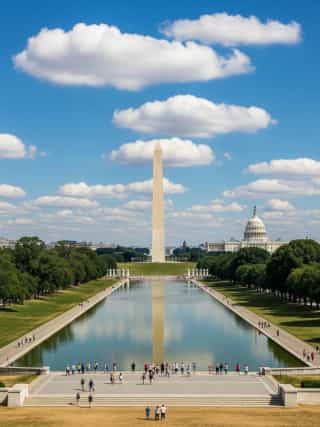
Washington, D.C. - The Capital of United States
- Population
- 689,545
- Language
- English
- Continent
- North America
- Since
- 1800
- Eco Ranking
- 35/195
Source: Environmental Performance Index 2024.
About Washington, D.C.
Washington, D.C. was purpose-built as the federal capital of the United States, established by the Residence Act of 1790. The site, on land ceded by Maryland along the Potomac River, was selected by President George Washington, and the city's layout was designed by French-born engineer Pierre Charles L'Enfant. The federal government relocated from Philadelphia to Washington in 1800. The city was burned by British forces during the War of 1812, damaging the Capitol and the White House. The District of Columbia occupies a constitutionally anomalous position. It is not a US state, meaning its residents lacked any Electoral College representation until the 23rd Amendment was ratified in 1961. Washington D.C. residents still have no voting representation in Congress, the city sends a non-voting delegate to the House and has no Senate representation, despite having a larger population than Wyoming or Vermont. Statehood for the District has been a recurring political issue. The city hosts the US Capitol (Congress), the White House (executive), the Supreme Court (judiciary), and the headquarters of every federal department. DC's local government has operated under home rule since 1973, but Congress retains the power to override DC legislation. The District's official motto, "Taxation Without Representation", appears on its vehicle licence plates.
About United States
The United States is a federal constitutional republic composed of 50 states, with powers divided between the federal government and the states. The federal government is structured around three branches: the legislative (Congress, comprising the Senate and House of Representatives), the executive (the president), and the judicial (Supreme Court). Washington D.C. serves as the seat of all three branches. The US operates a presidential system in which the president is both head of state and head of government, elected separately from Congress.
View Washington, D.C. on the map
Flight time from Washington, D.C. to other capitals
Capitals with similar population to Washington, D.C.
Capitals with similar eco ranking to Washington, D.C.
| City | Eco Rank |
|---|---|
| Minsk | 32 |
| Bucharest | 34 |
| Wellington | 34 |
| Washington, D.C. | 35 |
| Paramaribo | 36 |
| Sofia | 37 |
| Nassau | 38 |
Source: Environmental Performance Index 2024.
Frequently Asked Questions
Why was Washington D.C. built as a new city rather than using an existing one?
The US Constitution required a federal district not belonging to any single state, to prevent any state from having undue influence over the national government. A compromise in Congress led to the site on the Potomac River being selected, with land ceded by Maryland. Philadelphia had served as the interim capital during the constitutional period.
Why does Washington D.C. have no voting representation in Congress?
The US Constitution grants congressional representation to states, and Washington D.C. is a federal district, not a state. Despite having around 690,000 residents, more than Wyoming or Vermont, D.C. has only a non-voting delegate in the House and no Senate seats. The 23rd Amendment (1961) gave D.C. residents the right to vote in presidential elections.
When did the US government move to Washington D.C.?
The federal government officially moved to Washington D.C. in November 1800, when President John Adams relocated from Philadelphia. Congress convened in the partially completed Capitol building for the first time that year.
What happened to Washington D.C. during the War of 1812?
In August 1814, British forces captured and burned Washington D.C., setting fire to the Capitol building, the White House, and other federal structures. It remains the only time since independence that a foreign power has captured and occupied the US capital. President James Madison fled the city.
Is Washington D.C. the largest city in the United States?
No. Washington D.C. has a population of around 690,000, making it a mid-sized city by American standards. New York City is the largest US city, with over 8 million residents. Washington's metropolitan area is significantly larger, but the District itself is constitutionally limited in size.
Sights and landmarks
Climate and best time to visit
Culture and customs
Economy