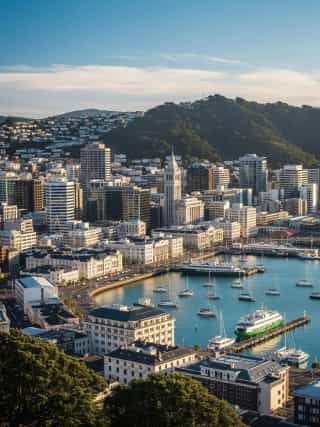
Wellington - The Capital of New Zealand
- Population
- 215,800
- Language
- English
- Continent
- Oceania
- Since
- 1865
- Eco Ranking
- 34/195
Source: Environmental Performance Index 2024.
About Wellington
Wellington has been New Zealand's capital since 1865, but it was not the country's first seat of government. Auckland served as the original capital from 1841 following the signing of the Treaty of Waitangi in 1840. As European settlement expanded southward, particularly onto the South Island, Auckland's northern location became politically untenable. A commission of Australian arbitrators recommended moving the capital to Wellington, which sits at the southern tip of the North Island and offers better access to both islands. Wellington functions as the sole seat of New Zealand's government. Parliament, the executive, and the Supreme Court are all located there. New Zealand operates a unicameral parliament under the Westminster system, with a governor-general representing the Crown as head of state. The country adopted a mixed-member proportional electoral system in 1996, significantly changing the composition and dynamics of parliament. Wellington is notable in the context of New Zealand's constitutional history: New Zealand was the first self-governing country in the world to grant women the right to vote, in 1893. Wellington is the southernmost national capital in the world.
About New Zealand
New Zealand is a constitutional monarchy and parliamentary democracy under the Westminster system. The monarch (currently King Charles III) is represented by a governor-general. The unicameral House of Representatives sits in Wellington and is elected by proportional representation. New Zealand has no written constitution, constitutional arrangements are derived from a combination of statutes, conventions, and the Treaty of Waitangi. The country gained full legislative independence from Britain via the Statute of Westminster Adoption Act 1947.
View Wellington on the map
Flight time from Wellington to other capitals
| City | Distance (km) | Flight Time |
|---|---|---|
| Canberra | 2300 | 2h 42m |
| Singapore | 8500 | 10h 0m |
| Tokyo | 9300 | 10h 56m |
| Buenos Aires | 10000 | 11h 46m |
| Cape Town | 11300 | 13h 18m |
| Washington, D.C. | 14100 | 16h 35m |
| Abu Dhabi | 14300 | 16h 49m |
| Rome | 18500 | 21h 46m |
| London | 18800 | 22h 7m |
| Paris | 19000 | 22h 21m |
Capitals with similar population to Wellington
Capitals with similar eco ranking to Wellington
| City | Eco Rank |
|---|---|
| Budapest | 31 |
| Minsk | 32 |
| Bucharest | 34 |
| Wellington | 34 |
| Washington, D.C. | 35 |
| Paramaribo | 36 |
| Sofia | 37 |
Source: Environmental Performance Index 2024.
Frequently Asked Questions
Why did New Zealand move its capital from Auckland to Wellington?
Auckland served as New Zealand's first capital from 1841, but as settlement expanded toward the South Island, Auckland's far-northern location was seen as geographically unsuitable for governing the whole country. In 1865, following a recommendation by Australian arbitrators, the capital was moved to Wellington, which is more centrally located relative to both islands.
Is Wellington the largest city in New Zealand?
No. Auckland is by far the largest city in New Zealand, with a population of over 1.6 million, roughly three times that of Wellington. This makes New Zealand somewhat unusual among countries where the capital is not the largest city, a situation that has periodically fuelled political debate about resource allocation.
What type of government does New Zealand have?
New Zealand is a constitutional monarchy and parliamentary democracy. The monarch is represented by a governor-general, and the prime minister leads the government. Parliament is unicameral, there is no upper house. New Zealand uses a mixed-member proportional electoral system, introduced in 1996.
What is Wellington's significance in women's suffrage history?
New Zealand, governed from Wellington, became the first self-governing country in the world to grant women the right to vote, in 1893. The Electoral Act was signed in Wellington on 19 September 1893, after a campaign led by Kate Sheppard. Women could vote in elections that same year.
Where is Wellington located geographically?
Wellington is situated at the southern tip of New Zealand's North Island, on the shores of Cook Strait, the body of water separating the North and South Islands. This location makes it the world's southernmost national capital and gives it a strategically central position relative to both of New Zealand's main islands.
Sights and landmarks
Climate and best time to visit
Culture and customs
Economy