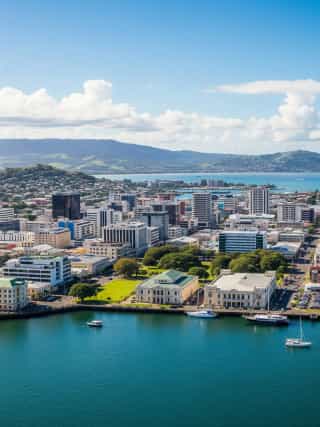
Suva - The Capital of Fiji
- Population
- 178,065
- Language
- English
- Continent
- Oceania
- Since
- 1877
- Eco Ranking
- 90/195
Source: Environmental Performance Index 2024.
About Suva
Suva became the capital of British Fiji in 1877, when colonial administrators relocated the seat of government from Levuka on the island of Ovalau. The move was driven by Suva's superior harbour and greater capacity for urban development. Fiji became independent from Britain in 1970, and Suva continued as the capital of the new state. Fiji's post-independence political history has been defined by coups. The military intervened in 1987 twice, first under Lieutenant Colonel Sitiveni Rabuka, who staged two coups that year to prevent a government dominated by Indo-Fijian political parties from taking office. Rabuka declared Fiji a republic, severing ties with the Commonwealth. A further coup occurred in 2000, and then again in December 2006, when Commodore Frank Bainimarama seized power, dissolving parliament and ruling by decree for years. Bainimarama justified the coup as necessary to end corruption and ethnic tensions. International sanctions followed, and Fiji was suspended from the Commonwealth and Pacific Islands Forum. A new constitution was introduced in 2013 and elections held in 2014, formally returning Bainimarama to power through the ballot. He governed until losing the 2022 general election to the Social Democratic Liberal Party. Suva houses the government, the parliament, and the Supreme Court, and serves as the main diplomatic hub of the South Pacific.
About Fiji
Fiji is a parliamentary republic with a president as head of state and a prime minister as head of government. The country has a complex ethnic composition, indigenous Fijians and Indo-Fijians (descendants of labourers brought by Britain) have historically competed for political power, fuelling several of the country's coups. Fiji is a member of the Pacific Islands Forum and rejoined the Commonwealth in 1997. Its 2013 constitution introduced measures intended to reduce ethnically based political competition.
View Suva on the map
Flight time from Suva to other capitals
| City | Distance (km) | Flight Time |
|---|---|---|
| Canberra | 3500 | 4h 7m |
| Tokyo | 7200 | 8h 28m |
| Singapore | 8400 | 9h 53m |
| Buenos Aires | 11600 | 13h 39m |
| Washington, D.C. | 12500 | 14h 42m |
| Cape Town | 13900 | 16h 21m |
| Abu Dhabi | 14200 | 16h 42m |
| London | 16300 | 19h 11m |
| Paris | 16600 | 19h 32m |
| Rome | 17100 | 20h 7m |
Capitals with similar population to Suva
| City | Population |
|---|---|
| Wellington | 215,800 |
| Podgorica | 187,085 |
| Suva | 178,065 |
| Praia | 168,000 |
| Port Louis | 149,194 |
| Gitega | 135,467 |
| Bern | 133,883 |
Capitals with similar eco ranking to Suva
Source: Environmental Performance Index 2024.
Frequently Asked Questions
Why is Suva the capital of Fiji?
Suva became Fiji's capital in 1877 when British colonial authorities moved the administrative centre from Levuka due to Suva's better harbour and more suitable land for development. It became the capital of independent Fiji in 1970. Its geographic position on Viti Levu, Fiji's main island, also made it a natural choice for the country's administrative hub.
How many coups has Fiji experienced?
Fiji has experienced four military coups: in 1987 (twice, both led by Sitiveni Rabuka), in 2000 (led by George Speight, a civilian backed by military elements), and in 2006 (led by Frank Bainimarama). These coups were driven by tensions over political representation between indigenous Fijians and Indo-Fijians, as well as disputes over governance and corruption.
Who is Frank Bainimarama?
Frank Bainimarama is the military commander who led the 2006 coup against Prime Minister Laisenia Qarase. He governed Fiji largely by decree until the 2014 elections, which he won after introducing a new constitution. He was re-elected in 2018 but lost the 2022 general election to Sitiveni Rabuka, son-in-law of the man who staged the 1987 coups.
When did Fiji gain independence?
Fiji gained independence from Britain on 10 October 1970. It initially became a constitutional monarchy within the Commonwealth but was declared a republic by Sitiveni Rabuka following the 1987 coups. Fiji was readmitted to the Commonwealth in 1997 after a new constitution was adopted.
Is Suva the largest city in Fiji?
Suva is the largest city in Fiji, with a population of approximately 178,000 in the urban area. It houses the central government, parliament, and Supreme Court, and serves as Fiji's main port and economic hub. The city is located on the southeastern coast of Viti Levu, Fiji's largest island.
Sights and landmarks
Climate and best time to visit
Culture and customs