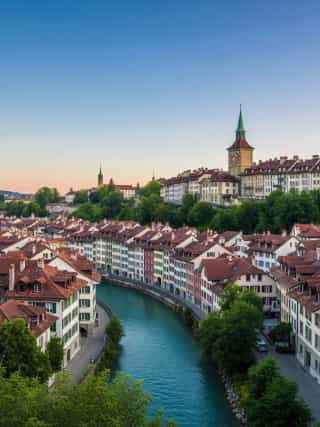
Bern - The Capital of Switzerland
- Population
- 133,883
- Language
- German
- Continent
- Europe
- Since
- 1848
- Eco Ranking
- 9/195
Source: Environmental Performance Index 2024.
About Bern
Bern occupies an unusual position in international political geography: Switzerland has no constitutionally designated capital city. Bern is referred to as the Bundesstadt, the 'federal city', a deliberate terminological choice that reflects the country's commitment to decentralized federalism. The Federal Council (the seven-member executive), the Federal Assembly (parliament), and the Federal Chancellery are all headquartered in Bern, making it the de facto seat of government. The arrangement dates to the founding of the modern Swiss federal state in 1848, when Bern was chosen as the federal city over rivals Zurich and Lucerne, partly for its central location and partly as a political compromise between Protestant and Catholic cantons. The Federal Palace, completed in 1902, is the seat of both the legislature and the Federal Council. Switzerland's highest court, however, sits in Lausanne, not Bern, a further expression of the deliberate distribution of state functions across cantons. Bern is also the capital of the Canton of Bern, one of Switzerland's largest cantons by area. The city has been a UNESCO World Heritage Site since 1983 for its medieval arcaded old town.
About Switzerland
Switzerland is a federal republic of 26 cantons, governed by a Federal Council of seven members who collectively serve as the executive, there is no single president in the conventional sense, as the presidency rotates annually among the councillors. Switzerland's model of direct democracy allows citizens to challenge federal laws and propose constitutional amendments through referendums, making it one of the most participatory political systems in the world.
View Bern on the map
Flight time from Bern to other capitals
| City | Distance (km) | Flight Time |
|---|---|---|
| Paris | 400 | 0h 28m |
| London | 700 | 0h 49m |
| Rome | 700 | 0h 49m |
| Abu Dhabi | 4800 | 5h 39m |
| Washington, D.C. | 6600 | 7h 46m |
| Cape Town | 9100 | 10h 42m |
| Tokyo | 9700 | 11h 25m |
| Singapore | 10400 | 12h 14m |
| Buenos Aires | 11200 | 13h 11m |
| Canberra | 16600 | 19h 32m |
Capitals with similar population to Bern
| City | Population |
|---|---|
| Port Louis | 149,194 |
| Gitega | 135,467 |
| Bern | 133,883 |
| Reykjavik | 131,136 |
| Luxembourg City | 128,514 |
| Georgetown | 118,363 |
| Sri Jayawardenepura Kotte | 115,826 |
Capitals with similar eco ranking to Bern
Source: Environmental Performance Index 2024.
Frequently Asked Questions
Is Bern officially the capital of Switzerland?
No. Switzerland has no constitutionally designated capital city. Bern is designated the Bundesstadt, or 'federal city,' and serves as the seat of the Federal Council, the Federal Assembly, and most federal administration, but it does not hold the legal status of capital. This reflects Switzerland's constitutional commitment to federalism and the dispersal of state power.
Why was Bern chosen as Switzerland's federal city?
When the modern Swiss Confederation was established in 1848, Bern was selected as the federal city over competing cities such as Zurich and Lucerne. Its central geographic location and its status as a political compromise between the dominant Protestant and Catholic cantons made it an acceptable choice for all parties.
Where is Switzerland's Supreme Court located?
Switzerland's Federal Supreme Court is located in Lausanne, not in Bern. This separation of judicial authority from the legislative and executive seat in Bern reflects Switzerland's principle of distributing state functions across different cities and cantons rather than concentrating them in a single capital.
How long has Bern been the seat of the Swiss federal government?
Bern has been the seat of the Swiss federal government since 1848, when the modern Swiss Confederation was founded. The Federal Palace, which houses both the parliament and the Federal Council, was completed in 1902 and has been the center of Swiss federal governance since then.
What is the population of Bern compared to other Swiss cities?
Bern has a city-proper population of around 134,000, making it Switzerland's fourth-largest city. Zurich, with around 430,000 residents, is significantly larger, as is Geneva. This is itself notable: Switzerland's de facto capital is not its largest or most economically prominent city, consistent with the country's dispersal of political and economic weight.
Sights and landmarks
Climate and best time to visit
Economy