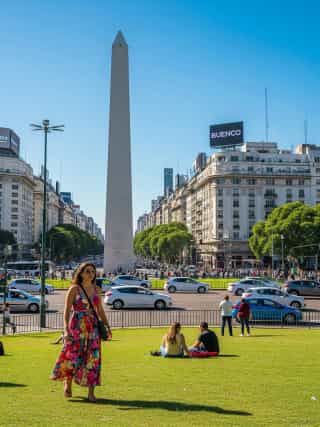
Buenos Aires - The Capital of Argentina
- Population
- 2,890,151
- Language
- Spanish
- Continent
- South America
- Since
- 1536
- Eco Ranking
- 81/195
Source: Environmental Performance Index 2024.
About Buenos Aires
Established as a permanent settlement in 1580 after an earlier failed attempt in 1536, Buenos Aires became the capital of the Viceroyalty of the Río de la Plata in 1776, a Spanish colonial administrative unit covering much of southern South America. After Argentine independence in 1816, control of the city became a central political conflict between federalists and unitarists for decades. The dispute was resolved in 1880 when Buenos Aires was federalized, made a distinct federal district separate from Buenos Aires Province, a structure analogous to Washington D.C. Today it houses the Casa Rosada (seat of the executive), the National Congress, and the Supreme Court. The city proper, the Autonomous City of Buenos Aires, is governed separately from the surrounding province of the same name and holds roughly 2.9 million residents, though the metropolitan area reaches approximately 15 million. Argentina has experienced more sovereign debt defaults than any other country in history, and Buenos Aires has been the political stage for each of those crises.
About Argentina
Argentina is a federal republic composed of 23 provinces plus the Autonomous City of Buenos Aires. The president holds executive power and is directly elected. The federal structure was a hard-won compromise following 19th-century civil conflict between centralists based in Buenos Aires and provincial interests. Argentina's recurring political instability, including a military dictatorship from 1976 to 1983, has shaped its constitutional framework, which was significantly reformed in 1994.
View Buenos Aires on the map
Flight time from Buenos Aires to other capitals
Capitals with similar population to Buenos Aires
Capitals with similar eco ranking to Buenos Aires
Source: Environmental Performance Index 2024.
Frequently Asked Questions
Why is Buenos Aires a federal district and not part of Buenos Aires Province?
Buenos Aires was federalized in 1880 to resolve a long-running conflict between the national government and the province over control of the capital. By making the city a separate federal district, no single province would hold disproportionate political power through ownership of the capital.
When did Buenos Aires become the capital of Argentina?
Buenos Aires was declared the permanent federal capital in 1880, though it had functioned as the de facto seat of government since independence in 1816. The 1880 federalization formally separated the city from Buenos Aires Province.
Is Buenos Aires the largest city in Argentina?
Yes. The city proper has a population of approximately 2.9 million, but the greater Buenos Aires metropolitan area is home to around 15 million people, roughly one third of Argentina's total population.
What is the Casa Rosada?
The Casa Rosada (Pink House) is the seat of the Argentine executive branch, where the president's offices are located. It sits on the Plaza de Mayo in central Buenos Aires and has been a focal point of Argentine political history, including the military coups of the 20th century.
Has Argentina ever considered moving its capital?
Yes. In 1987, President Raúl Alfonsín proposed moving the capital to Viedma in Patagonia to redistribute political and economic power away from Buenos Aires. The plan was approved by Congress but abandoned due to economic crisis and lack of sustained political will.
Sights and landmarks
Climate and best time to visit
Culture and customs
Economy