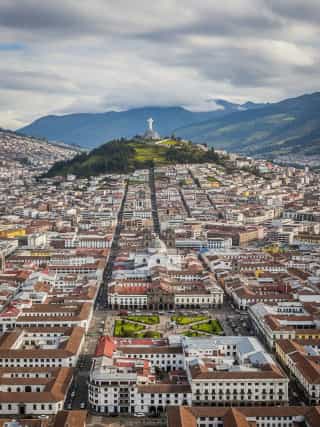
Quito - The Capital of Ecuador
- Population
- 2,781,641
- Language
- Spanish
- Continent
- South America
- Since
- 1534
- Eco Ranking
- 52/195
Source: Environmental Performance Index 2024.
About Quito
Established by Spanish conquistadors in 1534 on the ruins of an Inca settlement, Quito served as the administrative center of the Real Audiencia de Quito under colonial rule. When Ecuador declared independence in 1822, first as part of Gran Colombia, then as a sovereign republic in 1830, Quito was retained as capital, consolidating political authority in the Andean highlands. The city houses the executive, legislative, and judicial branches of government, along with the presidential palace on the Plaza Grande. Quito's political history has been turbulent: presidents were overthrown by popular uprisings in 2000 and 2005, and the country has cycled through periods of left-wing populism and market liberalism. At 2,850 metres above sea level, Quito is the second highest capital city in the world, after La Paz, Bolivia's seat of government. It is also the capital city geographically closest to the equator, sitting just 25 kilometres south of it.
About Ecuador
Ecuador is a presidential republic with a unicameral National Assembly. The 2008 constitution, passed under President Rafael Correa, granted rights to nature as a legal entity, a first globally. Ecuador uses the US dollar as its official currency, having adopted it in 2000 following a severe financial crisis that wiped out the sucre.
View Quito on the map
Flight time from Quito to other capitals
| City | Distance (km) | Flight Time |
|---|---|---|
| Washington, D.C. | 4300 | 5h 4m |
| Buenos Aires | 4400 | 5h 11m |
| London | 9200 | 10h 49m |
| Paris | 9400 | 11h 4m |
| Rome | 10100 | 11h 53m |
| Cape Town | 10600 | 12h 28m |
| Canberra | 13700 | 16h 7m |
| Abu Dhabi | 14300 | 16h 49m |
| Tokyo | 14400 | 16h 56m |
| Singapore | 19700 | 23h 11m |
Capitals with similar population to Quito
| City | Population |
|---|---|
| Guatemala City | 2,918,337 |
| Tashkent | 2,906,000 |
| Buenos Aires | 2,890,151 |
| Rome | 2,873,494 |
| Quito | 2,781,641 |
| Lusaka | 2,731,696 |
| Taipei | 2,646,204 |
Capitals with similar eco ranking to Quito
Source: Environmental Performance Index 2024.
Frequently Asked Questions
Why is Quito the capital of Ecuador?
Quito was designated the capital when Ecuador became an independent republic in 1830, continuing its role as the primary administrative centre established during Spanish colonial rule. Its position in the Andean highlands gave it strategic and administrative importance. The choice reflected the dominance of the highland (sierra) political elite over coastal interests centred in Guayaquil.
When did Quito become the capital of Ecuador?
Quito became Ecuador's capital in 1830 when the country separated from Gran Colombia and established itself as an independent republic. The city had already served as the seat of the Real Audiencia de Quito since 1563 under Spanish colonial administration, giving it centuries of governmental precedent.
Is Quito the largest city in Ecuador?
No. Guayaquil, the main port city on the Pacific coast, is Ecuador's most populous city with around 3 million inhabitants in its metropolitan area. Quito has approximately 2.8 million residents. The rivalry between the highland capital and the coastal commercial hub has been a defining feature of Ecuadorian political life.
How high above sea level is Quito?
Quito sits at approximately 2,850 metres (9,350 feet) above sea level, making it the second highest capital city in the world. Only La Paz in Bolivia, which functions as Bolivia's seat of government, is higher. Quito's elevation has practical consequences for governance and daily life, including lower oxygen levels and a climate cooler than its equatorial latitude would suggest.
Was Quito important before the Spanish arrived?
Yes. Quito was the capital of the northern Inca Empire, the Kingdom of Quito, before Spanish conquest. The Inca ruler Atahualpa was based in Quito when civil war broke out with his brother Huáscar in Cusco. When Spanish forces under Sebastián de Benalcázar arrived in 1534, the retreating Inca general Rumiñahui burned the city rather than surrender it.
Sights and landmarks
Climate and best time to visit
Regional significance
Culture and customs
Economy