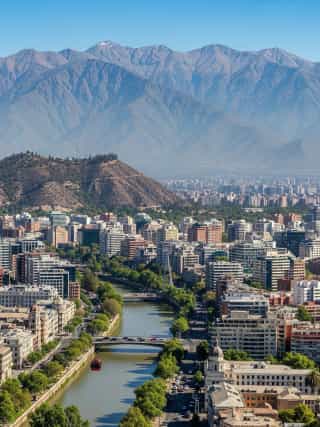
Santiago - The Capital of Chile
- Population
- 5,614,000
- Language
- Spanish
- Continent
- South America
- Since
- 1541
- Eco Ranking
- 68/195
Source: Environmental Performance Index 2024.
About Santiago
Founded by the Spanish conquistador Pedro de Valdivia in February 1541, Santiago became the administrative centre of the Captaincy General of Chile under Spanish colonial rule. It retained this role when Chile declared independence in 1818. The city's modern political history is defined in large part by 11 September 1973, when General Augusto Pinochet led a US-backed military coup against the democratically elected socialist president Salvador Allende. Allende died at the presidential palace, La Moneda, during the assault. The Pinochet dictatorship, headquartered in Santiago, ruled Chile from 1973 to 1990, during which thousands were killed, tortured, or forcibly disappeared. Chile returned to democratic governance in 1990 when Pinochet handed power to the elected president Patricio Aylwin. Today Santiago houses all three branches of government. The metropolitan region contains approximately 40% of Chile's total population, making Santiago's political dominance disproportionate to the country's geographically elongated territory.
About Chile
Chile is a presidential republic with a bicameral National Congress. Following the Pinochet dictatorship (1973-1990), Chile transitioned to democracy and has maintained consistent democratic governance since. Chile rejected a new constitution in a 2022 referendum, retaining the framework established under Pinochet and subsequently amended. Chile is one of Latin America's most economically stable countries.
View Santiago on the map
Flight time from Santiago to other capitals
| City | Distance (km) | Flight Time |
|---|---|---|
| Buenos Aires | 1100 | 1h 18m |
| Cape Town | 7900 | 9h 18m |
| Washington, D.C. | 8100 | 9h 32m |
| Canberra | 11300 | 13h 18m |
| Paris | 11600 | 13h 39m |
| London | 11700 | 13h 46m |
| Rome | 11900 | 14h 0m |
| Abu Dhabi | 14600 | 17h 11m |
| Singapore | 16400 | 19h 18m |
| Tokyo | 17200 | 20h 14m |
Capitals with similar population to Santiago
Capitals with similar eco ranking to Santiago
Source: Environmental Performance Index 2024.
Frequently Asked Questions
Why is Santiago the capital of Chile?
Santiago was founded in 1541 as the administrative centre of Spanish colonial Chile and remained the seat of government throughout the colonial period. When Chile became independent in 1818, Santiago's established role as the dominant city, politically, economically, and demographically, made it the unchallenged capital of the new republic.
What happened at La Moneda in 1973?
On 11 September 1973, Chilean military forces led by General Augusto Pinochet launched a coup against President Salvador Allende. La Moneda, the presidential palace in central Santiago, was bombed by the air force and stormed by troops. Allende died during the assault, officially by suicide, though the circumstances have been debated. The coup ended Chile's democratic government and installed a military dictatorship that lasted until 1990.
When did Chile return to democracy?
Chile returned to democracy in 1990 after a 1988 plebiscite, held under the terms of the Pinochet-era constitution, rejected Pinochet's continued rule. Elections were held in December 1989, and Patricio Aylwin of the centre-left coalition (Concertación) was inaugurated as president in March 1990, ending 17 years of military rule.
Is Santiago the largest city in Chile?
Yes. Santiago is by far Chile's largest city, with approximately 5.6 million residents in the municipality and around 8 million in the metropolitan region. The Santiago metropolitan region accounts for approximately 40% of Chile's total population. Chile's second city, Valparaíso, functions as the seat of the National Congress but has a population less than a tenth the size of Santiago's.
Where is Chile's National Congress located?
Chile's National Congress is located in Valparaíso, not in Santiago. The Congress was moved from Santiago to Valparaíso in 1990 as part of the democratic transition, a symbolic and practical step away from the seat of executive power. The presidency and most ministries remain in Santiago.
Sights and landmarks
Climate and best time to visit
Regional significance
Economy