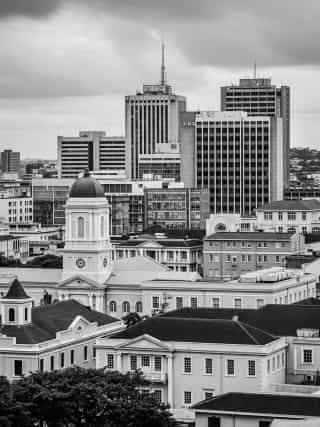
Kingston - The Capital of Jamaica
- Population
- 1,041,203
- Language
- English
- Continent
- North America
- Since
- 1872
- Eco Ranking
- 73/195
Source: Environmental Performance Index 2024.
About Kingston
Kingston was established in 1692 following the destruction of Port Royal, at the time one of the largest cities in the Americas, by a catastrophic earthquake. Port Royal, which had served as a major hub for colonial trade and the operations of privateers operating with British authorization, sank partially into the sea; survivors relocated to the settlement that became Kingston. The city grew as Jamaica's primary commercial and administrative center under British colonial rule, and formally replaced Spanish Town as the island's capital in 1872. Spanish Town had been the capital under both Spanish and British rule for over three centuries. Jamaica was a cornerstone of the British sugar economy and one of the most profitable colonial territories in the Atlantic world, with sugar production dependent on enslaved African labor on a massive scale. Emancipation came in 1834. Jamaica gained independence from Britain on August 6, 1962, with Kingston as its capital. The city houses the Parliament of Jamaica, the Office of the Prime Minister, and the Supreme Court. Kingston has also experienced persistent challenges with poverty and violence, particularly in the west of the city, shaped by political clientelism in which the two major parties, the Jamaica Labour Party and the People's National Party, historically maintained ties to armed garrison communities. Kingston is home to the University of the West Indies' Mona Campus, the leading academic institution in the anglophone Caribbean.
About Jamaica
Jamaica is a parliamentary democracy and constitutional monarchy with the British monarch as head of state, represented by a governor-general. It gained independence from Britain in 1962. Jamaica is a founding member of CARICOM and a significant contributor to the Caribbean Community's political and cultural identity. The country has maintained democratic governance since independence. There is an ongoing political debate about whether Jamaica should become a republic and remove the British monarch as head of state, an issue that gained momentum following similar moves by Barbados in 2021.
View Kingston on the map
Flight time from Kingston to other capitals
| City | Distance (km) | Flight Time |
|---|---|---|
| Washington, D.C. | 2300 | 2h 42m |
| Buenos Aires | 6200 | 7h 18m |
| London | 7500 | 8h 49m |
| Paris | 7700 | 9h 4m |
| Rome | 8600 | 10h 7m |
| Cape Town | 11600 | 13h 39m |
| Tokyo | 12900 | 15h 11m |
| Abu Dhabi | 12900 | 15h 11m |
| Canberra | 15100 | 17h 46m |
| Singapore | 17900 | 21h 4m |
Capitals with similar population to Kingston
Capitals with similar eco ranking to Kingston
| City | Eco Rank |
|---|---|
| Gaborone | 70 |
| Georgetown | 71 |
| Kingston | 73 |
| Bandar Seri Begawan | 74 |
| Belmopan | 75 |
| Jerusalem | 75 |
| Managua | 75 |
Source: Environmental Performance Index 2024.
Frequently Asked Questions
Why did Jamaica move its capital from Spanish Town to Kingston?
Kingston replaced Spanish Town as Jamaica's capital in 1872 following a long political debate. Kingston had grown to become Jamaica's largest and most commercially active city, and the colonial administration determined that governing from the smaller, inland Spanish Town was increasingly impractical. The move was controversial and resisted by Spanish Town interests.
When did Kingston become the capital of Jamaica?
Kingston officially became Jamaica's capital in 1872, when the colonial administration relocated from Spanish Town. It had been the island's main commercial city since the late 17th century, but Spanish Town had remained the seat of government for over 300 years under both Spanish and British rule.
What happened to Port Royal and how did it lead to Kingston?
Port Royal was a major colonial port town and privateer base that was partially destroyed by an earthquake and tsunami on June 7, 1692. Much of the city sank into the sea. Survivors relocated across the bay to establish Kingston, which grew to replace Port Royal as the primary settlement on the island.
When did Jamaica gain independence?
Jamaica gained independence from Britain on August 6, 1962. It became a constitutional monarchy with the British monarch as head of state, a status it retains today, though there is ongoing public debate about becoming a republic.
Is Kingston the largest city in Jamaica?
Yes, Kingston is Jamaica's largest city. The Kingston Metropolitan Area, which includes the neighboring municipality of St. Andrew, has a population of approximately 1 million, making it home to around one-third of Jamaica's entire population.
Sights and landmarks
Climate and best time to visit
Culture and customs
Economy