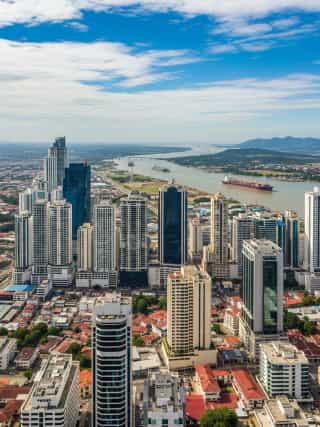
Panama City - The Capital of Panama
- Population
- 1,938,000
- Language
- Spanish
- Continent
- North America
- Since
- 1519
- Eco Ranking
- 48/195
Source: Environmental Performance Index 2024.
About Panama City
Founded by Spanish colonizers in 1519, Panama City is one of the oldest continuously inhabited European-established settlements on the Pacific coast of the Americas. Its political history is inseparable from its geography: the narrow isthmus connecting North and South America made it a transit and control point for colonial trade and, later, global commerce. Panama was part of the Viceroyalty of New Granada and subsequently the Republic of Colombia after independence. In 1903, Panama declared independence from Colombia with direct US diplomatic and military support, motivated almost entirely by the American intention to build a canal across the isthmus. The Hay-Bunau-Varilla Treaty, signed just days after independence, granted the US control over a 16-kilometer-wide Canal Zone in perpetuity. The Panama Canal opened in 1914 and remained under US control until December 31, 1999, when full sovereignty was transferred to Panama under the 1977 Torrijos-Carter Treaties. Panama City is home to the Panama Canal Authority, which operates and administers the canal. The city also serves as a regional financial and logistics hub. Panama's 1989 US military invasion to remove dictator Manuel Noriega, Operation Just Cause, left significant physical and political marks on the capital.
About Panama
Panama is a presidential republic with a unicameral National Assembly. The president serves as both head of state and government and is elected for five-year terms with no immediate re-election. Panama uses the US dollar as its currency alongside the Balboa, and its economy is oriented around the canal, logistics, and financial services. The 1977 Torrijos-Carter Treaties defined the framework for canal handover.
View Panama City on the map
Flight time from Panama City to other capitals
| City | Distance (km) | Flight Time |
|---|---|---|
| Washington, D.C. | 3300 | 3h 53m |
| Buenos Aires | 5300 | 6h 14m |
| London | 8500 | 10h 0m |
| Paris | 8700 | 10h 14m |
| Rome | 9500 | 11h 11m |
| Cape Town | 11300 | 13h 18m |
| Tokyo | 13600 | 16h 0m |
| Abu Dhabi | 13800 | 16h 14m |
| Canberra | 14300 | 16h 49m |
| Singapore | 18800 | 22h 7m |
Capitals with similar population to Panama City
Capitals with similar eco ranking to Panama City
| City | Eco Rank |
|---|---|
| Bridgetown | 46 |
| Brasília | 47 |
| Singapore | 47 |
| Panama City | 48 |
| Havana | 49 |
| Port of Spain | 49 |
| Abu Dhabi | 51 |
Source: Environmental Performance Index 2024.
Frequently Asked Questions
Why did Panama separate from Colombia?
Panama declared independence from Colombia in November 1903, backed by the United States, which wanted to build a canal across the isthmus. The Colombian Senate had rejected the Hay-Herrán Treaty that would have granted the US canal rights, prompting the US to support Panamanian separatists and immediately recognize the new republic.
When did the US hand over control of the Panama Canal?
The United States transferred full sovereignty over the Panama Canal to Panama on December 31, 1999, under the terms of the Torrijos-Carter Treaties signed in 1977. The canal zone had been under US control since the canal opened in 1914.
Why is Panama City significant beyond being a national capital?
Panama City hosts the Panama Canal Authority, which administers one of the world's most strategically important waterways. Approximately 5% of global maritime trade passes through the Panama Canal. The city is also a major regional financial center and logistics hub for Latin America.
What was Operation Just Cause?
Operation Just Cause was the US military invasion of Panama in December 1989, launched to remove the de facto ruler General Manuel Noriega. The operation resulted in Noriega's capture and extradition to the United States, where he was convicted of drug trafficking. The invasion killed hundreds of Panamanian civilians and military personnel.
Is Panama City the oldest city in the Americas on the Pacific coast?
Panama City, founded in 1519, is considered the oldest continuously inhabited European-founded city on the Pacific coast of the Americas. The original settlement, now called Panama Viejo, was destroyed in 1671 during a pirate attack and rebuilt at its current location shortly after.
Sights and landmarks
Climate and best time to visit
Culture and customs
Economy