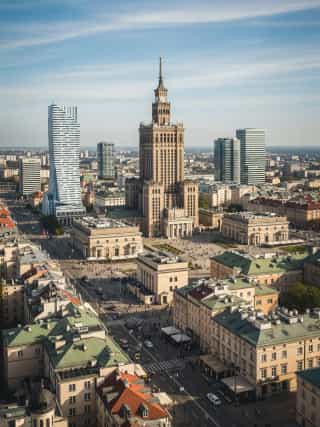
Warsaw - The Capital of Poland
- Population
- 1,790,658
- Language
- Polish
- Continent
- Europe
- Since
- 1596
- Eco Ranking
- 20/195
Source: Environmental Performance Index 2024.
About Warsaw
Warsaw replaced Kraków as Poland's capital in 1596, when King Sigismund III Vasa relocated the royal court northward, partly due to Warsaw's more central location within the Polish-Lithuanian Commonwealth, and partly following a fire that damaged Wawel Castle in Kraków. The city grew into a major European capital but endured repeated devastation: it was occupied and partitioned multiple times between Prussia, Russia, and Austria from the late 18th century onward. The most catastrophic chapter came during World War II. German forces occupied Warsaw in September 1939. The city's Jewish population, numbering around 400,000, was confined to a ghetto and largely deported to Treblinka extermination camp. Following the Ghetto Uprising of 1943 and then the broader Warsaw Uprising of 1944, the German army systematically demolished approximately 85% of the city building by building on Hitler's direct orders. Around 200,000 civilians died in the 1944 uprising alone. The postwar Polish government undertook an extraordinary reconstruction, rebuilding the Old Town from historical records, paintings, and the vedute of Bernardo Bellotto. The reconstructed Royal Castle and Old Town were designated a UNESCO World Heritage Site in 1980. Warsaw is the only capital in the world to have a UNESCO-listed reconstruction rather than an original historic center.
About Poland
Poland is a parliamentary republic and a member of both NATO and the European Union. The Sejm and Senate (parliament) sit in Warsaw, as does the Presidential Palace and the Council of Ministers. Poland experienced prolonged Soviet-aligned communist rule from 1945 to 1989, ending with the Solidarity-led transition to democracy. Poland joined NATO in 1999 and the EU in 2004. It shares borders with Russia's Kaliningrad exclave and Belarus, placing it at a strategically significant position on NATO's eastern flank.
View Warsaw on the map
Flight time from Warsaw to other capitals
| City | Distance (km) | Flight Time |
|---|---|---|
| Rome | 1300 | 1h 32m |
| London | 1400 | 1h 39m |
| Paris | 1400 | 1h 39m |
| Abu Dhabi | 4200 | 4h 56m |
| Washington, D.C. | 7200 | 8h 28m |
| Tokyo | 8600 | 10h 7m |
| Singapore | 9400 | 11h 4m |
| Cape Town | 9600 | 11h 18m |
| Buenos Aires | 12300 | 14h 28m |
| Canberra | 15600 | 18h 21m |
Capitals with similar population to Warsaw
Capitals with similar eco ranking to Warsaw
Source: Environmental Performance Index 2024.
Frequently Asked Questions
Why did Warsaw replace Kraków as Poland's capital?
Warsaw became Poland's capital in 1596 when King Sigismund III Vasa moved the royal court there from Kraków. The decision reflected Warsaw's more central position within the Polish-Lithuanian Commonwealth, whose territory extended far to the east and north. A fire at Wawel Castle in Kraków accelerated the move.
What happened to Warsaw during World War II?
Warsaw suffered more destruction than almost any other European capital in World War II. After the suppression of the 1944 Warsaw Uprising, German forces systematically demolished approximately 85% of the city on Hitler's orders, killing around 200,000 civilians. The city was almost entirely in ruins when Soviet forces arrived in January 1945.
How was Warsaw rebuilt after the war?
The postwar communist government undertook a comprehensive reconstruction of Warsaw, including the meticulous rebuilding of the Old Town using historical records, architectural surveys, and 18th-century paintings, notably the vedute of Bernardo Bellotto. The reconstructed historic center was inscribed on the UNESCO World Heritage List in 1980 as an exceptional example of near-total reconstruction.
Is Warsaw the largest city in Poland?
Yes, Warsaw is Poland's largest city, with a population of approximately 1.8 million within the city limits and over 3 million in the metropolitan area. It is also the country's main economic and political center, accounting for a disproportionate share of Polish GDP.
What was the Warsaw Uprising of 1944?
The Warsaw Uprising was an armed revolt by the Polish Home Army (Armia Krajowa) against German occupation, launched on 1 August 1944 as Soviet forces approached from the east. The uprising lasted 63 days before the Polish forces capitulated. The Soviet advance halted during the uprising; historians debate whether this was deliberate. The German reprisals resulted in the near-total destruction of the city.
Sights and landmarks
Climate and best time to visit
Culture and customs