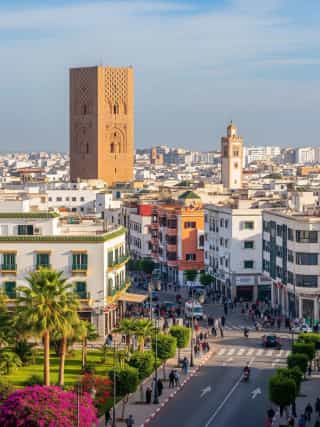
Rabat - The Capital of Morocco
- Population
- 1,777,000
- Language
- Arabic
- Continent
- Africa
- Since
- 1912
- Eco Ranking
- 130/195
Source: Environmental Performance Index 2024.
About Rabat
Rabat's status as Morocco's capital is a product of French imperial administration. When France established its protectorate over Morocco in 1912, it designated Rabat, rather than the historic imperial cities of Fez or Marrakech, as the administrative capital, favouring its coastal location and distance from entrenched local power structures. Morocco regained independence in 1956, and Rabat was retained as the seat of government. Today it houses the royal palace, the parliament, and the principal ministries. Morocco is a constitutional monarchy, with King Mohammed VI holding executive authority that substantially exceeds that of most European monarchs, the king appoints the prime minister, chairs the Council of Ministers, and serves as Commander of the Faithful. Rabat is also home to the country's diplomatic corps. The city is not Morocco's largest: Casablanca, the economic hub on the Atlantic coast, has more than twice Rabat's population and dominates the country's commercial life.
About Morocco
Morocco is a constitutional monarchy in which the king retains significant executive powers. The country borders both the Atlantic Ocean and the Mediterranean Sea. Morocco administers the territory of Western Sahara, whose sovereignty is disputed, the Polisario Front, backed by Algeria, claims it as an independent state, making it one of Africa's longest-running territorial disputes.
View Rabat on the map
Flight time from Rabat to other capitals
| City | Distance (km) | Flight Time |
|---|---|---|
| Paris | 1800 | 2h 7m |
| Rome | 1900 | 2h 14m |
| London | 2000 | 2h 21m |
| Abu Dhabi | 5900 | 6h 56m |
| Washington, D.C. | 6100 | 7h 11m |
| Cape Town | 8000 | 9h 25m |
| Buenos Aires | 9300 | 10h 56m |
| Tokyo | 11500 | 13h 32m |
| Singapore | 11800 | 13h 53m |
| Canberra | 17800 | 20h 56m |
Capitals with similar population to Rabat
Capitals with similar eco ranking to Rabat
Source: Environmental Performance Index 2024.
Frequently Asked Questions
Why is Rabat the capital of Morocco and not Casablanca?
Rabat was chosen as the administrative capital by France when it established its protectorate in 1912, primarily for practical and political reasons: its coastal accessibility and its separation from the powerful traditional elites concentrated in Fez and Marrakech. When Morocco became independent in 1956, the government retained Rabat as the capital. Casablanca was developed as the country's commercial and industrial centre.
When did Rabat become the capital of Morocco?
Rabat became Morocco's administrative capital in 1912, when the French Protectorate was established under the Treaty of Fez. Before that, Morocco had historically rotated between imperial capitals, principally Fez, Marrakech, Meknès, and Rabat itself, which had been a notable city since the 12th century.
What type of government does Morocco have?
Morocco is a constitutional monarchy. The king holds substantial executive authority, including the power to appoint and dismiss the prime minister and ministers, dissolve parliament, and issue royal decrees. The 2011 constitution, adopted following Arab Spring protests, transferred some powers to the elected government but left the monarchy as the dominant political force.
Has Fez ever been the capital of Morocco?
Yes. Fez served as Morocco's imperial capital for much of its history, functioning as the political and religious centre of the Marinid, Wattasid, and later Alaoui dynasties. Marrakech and Meknès also held capital status at various periods. The Alaoui dynasty, which rules Morocco today, has governed since the 17th century.
Is Rabat the largest city in Morocco?
No. Casablanca is Morocco's largest city, with a population exceeding 3.7 million in the city proper and over 4.7 million in its metropolitan area. Rabat has approximately 1.8 million residents. Despite being the political capital, Rabat plays a secondary role to Casablanca in economic and demographic terms.
Sights and landmarks
Climate and best time to visit
Culture and customs
Economy