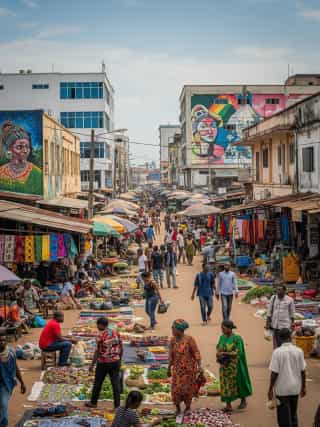
Lomé - The Capital of Togo
- Population
- 1,746,000
- Language
- French
- Continent
- Africa
- Since
- 1960
- Eco Ranking
- 151/195
Source: Environmental Performance Index 2024.
About Lomé
Lomé became the capital of Togo upon independence from French administration on 27 April 1960. Located on Togo's southern Atlantic coast, it sits directly on the border with Ghana, one of the few African capitals located on an international land border. The city was an important colonial administrative center under German rule (as part of Togoland) and later under French mandate. Togo has been governed by the Gnassingbé family since 1967, when General Gnassingbé Eyadéma seized power in a coup. He ruled until his death in February 2005, at which point the military immediately installed his son, Faure Gnassingbé, as president, bypassing the constitutional succession process. Faure subsequently won elections in 2005, 2010, 2015, and 2020, in contests that opposition groups and international observers characterized as flawed. This makes the Gnassingbé dynasty one of the longest-running continuous political families in power in Africa. Lomé is the seat of the National Assembly, the presidency, and the main government ministries. It also serves as Togo's main port. A constitutional amendment in 2019 reset the presidential term limit clock, allowing Faure Gnassingbé to potentially remain in power until 2030.
About Togo
Togo is a narrow West African republic bordered by Ghana, Benin, and Burkina Faso, with a short coastline on the Gulf of Guinea. It was a German colony until World War I, then administered under French mandate until independence in 1960. The country has been governed by the Gnassingbé family for more than five decades. Togo is a member of the Economic Community of West African States (ECOWAS) and the African Union. Phosphate mining and agriculture form the backbone of the economy.
View Lomé on the map
Flight time from Lomé to other capitals
| City | Distance (km) | Flight Time |
|---|---|---|
| Rome | 4100 | 4h 49m |
| Paris | 4800 | 5h 39m |
| Cape Town | 4800 | 5h 39m |
| London | 5000 | 5h 53m |
| Abu Dhabi | 6000 | 7h 4m |
| Buenos Aires | 7700 | 9h 4m |
| Washington, D.C. | 8600 | 10h 7m |
| Singapore | 11400 | 13h 25m |
| Tokyo | 13700 | 16h 7m |
| Canberra | 15400 | 18h 7m |
Capitals with similar population to Lomé
Capitals with similar eco ranking to Lomé
Source: Environmental Performance Index 2024.
Frequently Asked Questions
When did Lomé become the capital of Togo?
Lomé became the capital of independent Togo on 27 April 1960, when Togo gained independence from French administration. The city had served as the administrative capital under both German colonial rule and the subsequent French League of Nations mandate and UN trusteeship.
How long has the Gnassingbé family ruled Togo?
The Gnassingbé family has controlled Togo since 1967, when General Gnassingbé Eyadéma seized power in a coup. Following his death in 2005, his son Faure Gnassingbé has been president ever since, giving the family a continuous hold on power of more than 55 years, one of the longest political dynasties in the world.
How did Faure Gnassingbé come to power?
When Gnassingbé Eyadéma died on 5 February 2005, the Togolese military immediately installed his son Faure Gnassingbé as president, bypassing the constitutional requirement for the National Assembly speaker to assume the interim presidency. Under international pressure, Faure stood down temporarily and then won a presidential election in April 2005 that was criticized by opposition groups and international observers.
Is Lomé on an international border?
Yes. Lomé sits directly on the border between Togo and Ghana, making it one of the very few national capitals in the world located immediately on an international land border. The city's main commercial street effectively marks the boundary with Ghana's Aflao border town.
Is Lomé the largest city in Togo?
Yes, Lomé is the largest city in Togo with a population of approximately 1.75 million, representing a substantial share of Togo's total population of around 8 million. As the country's only major port, Lomé dominates Togo's economic and political life.
Sights and landmarks
Climate and best time to visit
Culture and customs
Economy