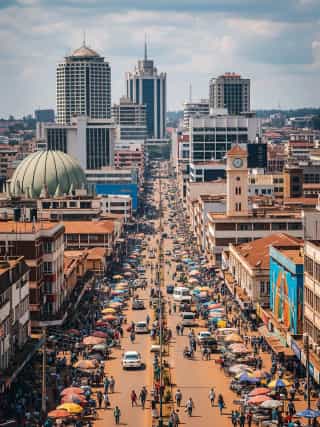
Kampala - The Capital of Uganda
- Population
- 1,680,000
- Language
- English
- Continent
- Africa
- Since
- 1962
- Eco Ranking
- 150/195
Source: Environmental Performance Index 2024.
About Kampala
Kampala, built across a series of hills in the central region of Uganda, developed from a site that held particular importance for the Buganda Kingdom, the most powerful of the pre-colonial kingdoms in the region. The name Kampala derives from the Luganda word for impala, as the area served as a royal hunting ground for the Buganda kabaka (king). British colonial authorities established an administrative center adjacent to the Buganda royal capital at Mengo in the late 19th century, and Kampala grew into the colonial capital of the Uganda Protectorate. Upon Uganda's independence from Britain on October 9, 1962, Kampala became the national capital. Post-independence Uganda experienced severe political violence: Idi Amin seized power in a coup in 1971 and ruled until 1979, during which time an estimated 100,000 to 500,000 Ugandans were killed. Further instability followed before Yoweri Museveni's National Resistance Movement came to power in 1986. Museveni has governed Uganda continuously since 1986, making him one of Africa's longest-serving leaders. Constitutional term limits were removed in 2005, and the age cap for presidential candidates was eliminated in 2017, allowing Museveni to extend his rule indefinitely. Kampala houses the Parliament of Uganda, the Supreme Court, and the presidency. The Buganda Kingdom continues to exist as a cultural institution with its palace (Lubiri) located in Kampala.
About Uganda
Uganda is a presidential republic in East Africa that gained independence from Britain in 1962. President Yoweri Museveni has governed continuously since seizing power in 1986. Constitutional amendments in 2005 removed presidential term limits, and a 2017 amendment eliminated the age cap on candidates, entrenching his rule. Uganda has a rapidly growing population, one of the world's youngest, and hosts one of Africa's largest refugee populations, primarily from South Sudan and the Democratic Republic of Congo.
View Kampala on the map
Flight time from Kampala to other capitals
| City | Distance (km) | Flight Time |
|---|---|---|
| Abu Dhabi | 3600 | 4h 14m |
| Cape Town | 4100 | 4h 49m |
| Rome | 5000 | 5h 53m |
| Paris | 6100 | 7h 11m |
| London | 6500 | 7h 39m |
| Singapore | 7900 | 9h 18m |
| Buenos Aires | 10100 | 11h 53m |
| Tokyo | 11500 | 13h 32m |
| Washington, D.C. | 11700 | 13h 46m |
| Canberra | 12400 | 14h 35m |
Capitals with similar population to Kampala
Capitals with similar eco ranking to Kampala
| City | Eco Rank |
|---|---|
| Port-au-Prince | 146 |
| Addis Ababa | 147 |
| São Tomé | 148 |
| N'Djamena | 149 |
| Kampala | 150 |
| Lomé | 151 |
| Beijing | 154 |
Source: Environmental Performance Index 2024.
Frequently Asked Questions
Why is Kampala built on hills?
Kampala's development across multiple hills reflects both its origins in the Buganda Kingdom, where hills held political and ceremonial significance, with the kabaka's palace on Mengo Hill, and the colonial-era pattern of building administrative centers on elevated ground for defensive and practical purposes. The city now extends across more than 20 hills.
When did Kampala become the capital of Uganda?
Kampala became the capital of independent Uganda on October 9, 1962, when the country gained independence from Britain. It had served as the administrative center of the British Uganda Protectorate from the colonial period.
How long has Yoweri Museveni governed Uganda from Kampala?
Yoweri Museveni has governed Uganda from Kampala since January 1986, when his National Resistance Movement came to power following a guerrilla war. As of 2024, he has been in power for nearly 40 years, making him one of the world's longest-serving heads of government.
What was Idi Amin's impact on Kampala?
Idi Amin ruled Uganda from Kampala from 1971 to 1979, following a military coup. His regime was marked by mass killings, the expulsion of Uganda's Asian population in 1972, and the dismantling of government institutions. Estimates of those killed under Amin range from 100,000 to 500,000, and Kampala's economy and infrastructure deteriorated severely.
What is the Buganda Kingdom's relationship to Kampala today?
The Buganda Kingdom continues to exist as a cultural and traditional institution within Uganda. The Kabaka of Buganda maintains a palace (the Lubiri or Mengo Palace) in Kampala, and the kingdom exercises cultural and social influence in the region. However, it holds no formal political authority within Uganda's republican system of government.
Sights and landmarks
Climate and best time to visit
Culture and customs
Economy