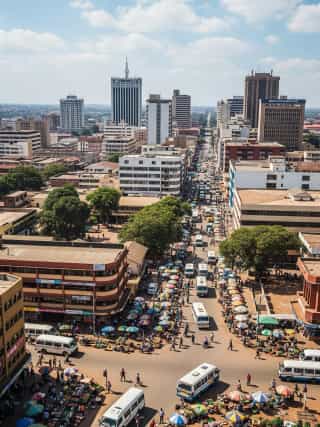
Lusaka - The Capital of Zambia
- Population
- 2,731,696
- Language
- English
- Continent
- Africa
- Since
- 1964
- Eco Ranking
- 84/195
Source: Environmental Performance Index 2024.
About Lusaka
Lusaka replaced Livingstone as the capital of Northern Rhodesia in 1935 under British colonial administration, chosen primarily for its central location and rail connectivity. It became the capital of independent Zambia on 24 October 1964. The city takes its name from a local Lenje chief, Lusaka, whose village occupied the site. Under Kenneth Kaunda, Zambia's first president, Lusaka was the seat of a one-party state from 1972 until 1991. Kaunda governed through the United National Independence Party (UNIP), nationalizing major industries including the crucial copper sector. In 1991, Zambia held multiparty elections in which Frederick Chiluba's Movement for Multi-party Democracy (MMD) defeated Kaunda, making Zambia one of the first African countries to achieve a peaceful, democratic transfer of power from a founding independence leader. This transition, managed from Lusaka, became a model for the wave of African democratization in the 1990s. Lusaka is the seat of the National Assembly, the presidency, and all central government ministries. Zambia was the first country in the world to default on its debt following the COVID-19 pandemic, in November 2020.
About Zambia
Zambia is a landlocked republic in southern-central Africa, bordered by eight countries including the Democratic Republic of the Congo, Tanzania, and Zimbabwe. It gained independence from Britain on 24 October 1964. Zambia's economy is heavily dependent on copper, and fluctuations in copper prices have driven major economic cycles. The country has a multiparty system and has experienced several peaceful transfers of power. In 2021, Hakainde Hichilema of the UPND won the presidential election, defeating incumbent Edgar Lungu, another in a series of democratic transitions.
View Lusaka on the map
Flight time from Lusaka to other capitals
| City | Distance (km) | Flight Time |
|---|---|---|
| Cape Town | 2300 | 2h 42m |
| Abu Dhabi | 5300 | 6h 14m |
| Rome | 6600 | 7h 46m |
| Paris | 7600 | 8h 56m |
| London | 7900 | 9h 18m |
| Singapore | 8500 | 10h 0m |
| Buenos Aires | 8800 | 10h 21m |
| Canberra | 11600 | 13h 39m |
| Washington, D.C. | 12400 | 14h 35m |
| Tokyo | 12900 | 15h 11m |
Capitals with similar population to Lusaka
| City | Population |
|---|---|
| Buenos Aires | 2,890,151 |
| Rome | 2,873,494 |
| Quito | 2,781,641 |
| Lusaka | 2,731,696 |
| Taipei | 2,646,204 |
| Port-au-Prince | 2,618,894 |
| Mogadishu | 2,610,483 |
Capitals with similar eco ranking to Lusaka
Source: Environmental Performance Index 2024.
Frequently Asked Questions
When did Lusaka become the capital of Zambia?
Lusaka became the capital of independent Zambia on 24 October 1964, when the country gained independence from Britain. It had already served as the capital of British Northern Rhodesia since 1935, when the colonial administration moved the seat of government from Livingstone due to Lusaka's more central location and railway connections.
Why was Lusaka chosen as the capital instead of Livingstone?
The British colonial administration moved the capital from Livingstone to Lusaka in 1935 primarily because of Lusaka's location near the center of the territory and its position on the Cape-to-Cairo railway line. Livingstone, on the southern border near Victoria Falls, was seen as too peripheral for effective administration of the entire territory.
What was significant about Zambia's 1991 election?
Zambia's 1991 election was one of the first instances of a peaceful democratic transfer of power from a post-independence African leader. Kenneth Kaunda, who had ruled since 1964 and had moved to one-party rule in 1972, accepted the election result and stepped down when Frederick Chiluba and the MMD won. It was a landmark moment in the broader wave of African democratization.
Is Lusaka the largest city in Zambia?
Yes, Lusaka is the largest city in Zambia with a population of approximately 2.7 million. It is also the country's main economic center. The Copperbelt cities of Ndola and Kitwe are significant urban centers but considerably smaller than the capital.
What does the name Lusaka mean?
Lusaka takes its name from a local Lenje chief whose village was located at the site where the town was established. Unlike many African capitals whose names derive from European colonial designations or geographical features, Lusaka has a straightforwardly African origin tied to the indigenous population of the area.
Sights and landmarks
Climate and best time to visit
Regional significance
Economy