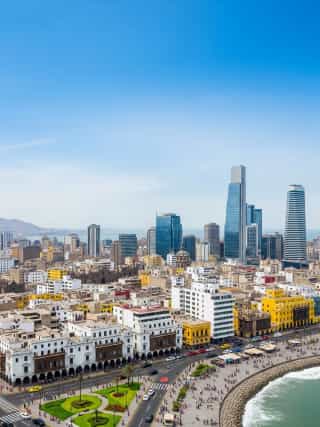
Lima - The Capital of Peru
- Population
- 10,719,000
- Language
- Spanish
- Continent
- South America
- Since
- 1535
- Eco Ranking
- 86/195
Source: Environmental Performance Index 2024.
About Lima
Lima was founded on 18 January 1535 by Spanish conquistador Francisco Pizarro, who named it the 'City of Kings' (Ciudad de los Reyes). It was chosen as the administrative headquarters of the Viceroyalty of Peru, which became the most powerful Spanish colonial institution in South America, overseeing the extraction and export of silver and other resources from the continent. For nearly 300 years, Lima functioned as the political and economic capital of Spanish South America. Peru declared independence in 1821, and Lima became the capital of the new republic. The city's political history through the 19th and 20th centuries was marked by repeated military coups, civilian governments, and periods of authoritarian rule, including the presidency of Alberto Fujimori (1990-2000), who was later convicted of human rights abuses and corruption. Peru has experienced extreme governmental instability in recent decades, with six presidents in five years between 2018 and 2023. Lima contains roughly one-third of Peru's total population, creating a degree of political and economic centralization that has generated persistent regional tensions. The city sits in one of the world's driest coastal deserts, receiving almost no rainfall.
About Peru
Peru is a unitary presidential republic on the Pacific coast of South America. It gained independence from Spain on 28 July 1821. The country has experienced chronic political instability: since 2016, every elected president has either been impeached, imprisoned, or forced to resign. Peru's constitution, adopted in 1993 under Fujimori, established the current governmental framework. The country is home to a significant portion of the Amazon rainforest and is one of the world's leading producers of copper, gold, and silver.
View Lima on the map
Flight time from Lima to other capitals
| City | Distance (km) | Flight Time |
|---|---|---|
| Buenos Aires | 3100 | 3h 39m |
| Washington, D.C. | 5700 | 6h 42m |
| Cape Town | 9800 | 11h 32m |
| London | 10200 | 12h 0m |
| Paris | 10300 | 12h 7m |
| Rome | 10900 | 12h 49m |
| Canberra | 12900 | 15h 11m |
| Abu Dhabi | 14700 | 17h 18m |
| Tokyo | 15500 | 18h 14m |
| Singapore | 18800 | 22h 7m |
Capitals with similar population to Lima
Capitals with similar eco ranking to Lima
Source: Environmental Performance Index 2024.
Frequently Asked Questions
When did Lima become the capital of Peru?
Lima became the capital of independent Peru upon the declaration of independence from Spain on 28 July 1821. However, the city had already served for nearly 300 years as the capital of the Spanish Viceroyalty of Peru, making it the dominant administrative center of Spanish South America from its founding in 1535.
Why did Francisco Pizarro found Lima where he did?
Pizarro chose the site on the Rímac River valley in January 1535 primarily for its proximity to the Pacific coast port of Callao, which allowed direct sea communication with Spain. The location also offered a defendable position and access to fresh water. The site replaced Jauja, which Pizarro had initially designated as his administrative headquarters but found too remote.
What was the Viceroyalty of Peru?
The Viceroyalty of Peru was the principal Spanish colonial administrative unit in South America, established in 1542 and headquartered in Lima. At its peak it governed most of South America. It was the primary conduit for the extraction of silver from mines at Potosí, which funded the Spanish empire for over two centuries.
Is Lima the largest city in Peru?
Yes, Lima is overwhelmingly the largest city in Peru, with approximately 10.7 million people in the city and more than 11 million in the metropolitan area, representing roughly one-third of Peru's total national population. This extreme concentration is a legacy of Lima's dominant role during both the colonial and republican periods.
Why has Peru had so many presidents in recent years?
Peru's constitution provides for presidential impeachment on grounds of 'moral incapacity,' a vague standard that Congress has applied repeatedly. Since 2016, multiple presidents have been removed or resigned: Pedro Pablo Kuczynski resigned in 2018, Martín Vizcarra was impeached in 2020, Manuel Merino resigned after protests in 2020, and Pedro Castillo was impeached in 2022 after attempting to dissolve Congress. Political polarization and corruption investigations have driven the cycle.
Sights and landmarks
Climate and best time to visit
Culture and customs