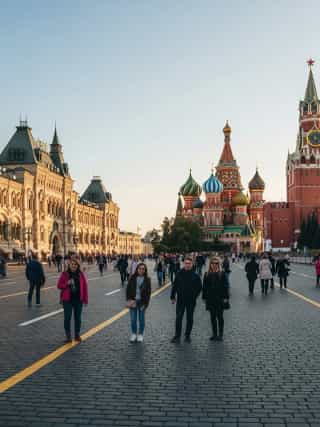
Moscow - The Capital of Russia
- Population
- 12,593,252
- Language
- Russian
- Continent
- Europe
- Since
- 1480
- Eco Ranking
- 84/195
Source: Environmental Performance Index 2024.
About Moscow
Moscow became the seat of the Grand Duchy of Muscovy in the 15th century and served as the capital of the Tsardom of Russia from 1480 until 1712, when Peter the Great transferred the capital to the newly founded St. Petersburg. The Bolsheviks moved the capital back to Moscow in March 1918, fearing a German advance on Petrograd (St. Petersburg) during World War I. Moscow has been the capital of the Soviet Union and then the Russian Federation ever since. The city is the seat of the Russian presidency, government, and parliament (the State Duma and Federation Council), all located within or near the Kremlin and its surrounding area. With a population of over 12.5 million, Moscow is the largest city in Europe. Russia's invasion of Ukraine, ordered from Moscow in February 2022, triggered the largest military conflict in Europe since World War II and resulted in sweeping international sanctions against Russia and its leadership. The Kremlin, originally a medieval fortress, functions today as the official residence of the President of Russia and the symbolic center of Russian state power. Moscow accounts for approximately 20 percent of Russia's entire GDP.
About Russia
Russia is a federal semi-presidential republic in which Vladimir Putin has held dominant power since 2000, serving as either president or prime minister. The 2020 constitutional amendments reset Putin's term count, theoretically allowing him to remain in power until 2036. Russia spans 11 time zones and is the world's largest country by territory. Its 2022 invasion of Ukraine resulted in international isolation, comprehensive Western sanctions, and Finland and Sweden joining NATO. Russia is a permanent member of the UN Security Council and possesses the world's largest nuclear arsenal.
View Moscow on the map
Flight time from Moscow to other capitals
| City | Distance (km) | Flight Time |
|---|---|---|
| Rome | 2400 | 2h 49m |
| London | 2500 | 2h 56m |
| Paris | 2500 | 2h 56m |
| Abu Dhabi | 3700 | 4h 21m |
| Tokyo | 7500 | 8h 49m |
| Washington, D.C. | 7800 | 9h 11m |
| Singapore | 8400 | 9h 53m |
| Cape Town | 10100 | 11h 53m |
| Buenos Aires | 13500 | 15h 53m |
| Canberra | 14500 | 17h 4m |
Capitals with similar population to Moscow
Capitals with similar eco ranking to Moscow
Source: Environmental Performance Index 2024.
Frequently Asked Questions
Why was Moscow replaced as Russia's capital by St. Petersburg?
Tsar Peter the Great founded St. Petersburg in 1703 and transferred the Russian capital there in 1712 as part of his effort to modernize Russia and orient it toward Western Europe. St. Petersburg, built on the Baltic coast, was designed to be Russia's "window to the West" and remained the capital until 1918.
When did Moscow become the capital of Russia again?
Moscow was restored as Russia's capital in March 1918, when the Bolshevik government relocated from Petrograd (now St. Petersburg) due to fears of a German military advance during World War I. It has remained the capital of the Soviet Union and subsequently the Russian Federation.
Is Moscow the largest city in Europe?
Yes. Moscow is the largest city in Europe by population, with over 12.5 million residents within the city proper. The metropolitan area is significantly larger. No other European city approaches this size.
What is the Kremlin's political function today?
The Moscow Kremlin is the official workplace and residence of the President of Russia and the symbolic seat of Russian state power. It houses the presidential administration, several government offices, and is the site where major state functions and ceremonies take place. The name 'Kremlin' is often used as shorthand for the Russian government itself.
How has Russia's invasion of Ukraine in 2022 affected Moscow's international standing?
Russia's February 2022 invasion of Ukraine, directed from Moscow, led to the most comprehensive package of Western sanctions imposed on any major economy, including asset freezes, export controls, and the exclusion of Russian banks from the SWIFT financial system. Russia was suspended from the Council of Europe and faced widespread condemnation at the UN. Moscow-based oligarchs and officials were personally targeted with asset seizures.
Sights and landmarks
Climate and best time to visit
Economy