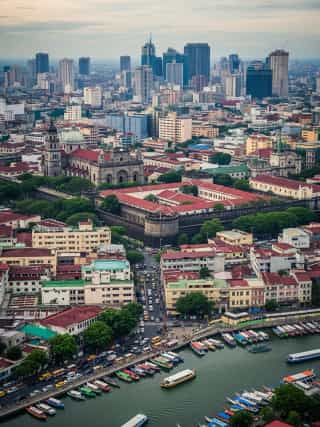
Manila - The Capital of Philippines
- Population
- 13,484,462
- Language
- Filipino
- Continent
- Asia
- Since
- 1898
- Eco Ranking
- 169/195
Source: Environmental Performance Index 2024.
About Manila
Manila has served as the political center of the Philippines since Spanish colonial forces under Miguel López de Legazpi established their capital there in 1571. The city functioned as the hub of the Manila Galleon Trade, the transpacific commercial route connecting Asia to Spanish America that ran for 250 years. Following the Spanish-American War of 1898, the Philippines was ceded by Spain to the United States, and Manila became the capital of the American colonial administration. The Battle of Manila in February-March 1945 was one of the most destructive urban battles of World War II: Japanese forces killed an estimated 100,000 Filipino civilians, and American bombardment destroyed much of the historic Intramuros district. Manila was heavily damaged and has never fully recovered its pre-war urban fabric. The Philippines became independent on 4 July 1946, with Manila as capital. The country was governed under the authoritarian rule of Ferdinand Marcos from 1972 to 1986, before the People Power Revolution, a mass civilian uprising centered in Manila, peacefully ousted him. Manila is the seat of government, though Metro Manila encompasses 16 cities and municipalities. Ferdinand Marcos Jr. became president in 2022, 36 years after his father's overthrow.
About Philippines
The Philippines is a archipelagic republic in Southeast Asia comprising over 7,600 islands. It was a Spanish colony from 1565 to 1898, then a US territory until 1946. The country is a presidential republic with a bicameral Congress. It has experienced significant political turbulence, including the Marcos dictatorship (1972-1986), the People Power Revolution, and the presidency of Rodrigo Duterte (2016-2022), whose anti-drug campaign resulted in thousands of extrajudicial killings. The Philippines maintains a defense treaty with the United States.
View Manila on the map
Flight time from Manila to other capitals
| City | Distance (km) | Flight Time |
|---|---|---|
| Singapore | 2400 | 2h 49m |
| Tokyo | 3000 | 3h 32m |
| Canberra | 6300 | 7h 25m |
| Abu Dhabi | 7000 | 8h 14m |
| Rome | 10400 | 12h 14m |
| London | 10700 | 12h 35m |
| Paris | 10700 | 12h 35m |
| Cape Town | 12100 | 14h 14m |
| Washington, D.C. | 13800 | 16h 14m |
| Buenos Aires | 17800 | 20h 56m |
Capitals with similar population to Manila
Capitals with similar eco ranking to Manila
| City | Eco Rank |
|---|---|
| Guatemala City | 167 |
| Djibouti | 168 |
| Dushanbe | 168 |
| Manila | 169 |
| Phnom Penh | 170 |
| Kabul | 171 |
| Baghdad | 172 |
Source: Environmental Performance Index 2024.
Frequently Asked Questions
When did Manila become the capital of the Philippines?
Manila became the capital of the Spanish Philippines in 1571 when Miguel López de Legazpi established the colonial administration there. It retained that status under American colonial rule from 1898, became the capital of the independent Commonwealth of the Philippines in 1935, and of fully independent Philippines on 4 July 1946. Quezon City briefly served as the official capital from 1948 to 1976, but Manila has been the effective and then again official capital since.
What happened to Manila during World War II?
Manila suffered catastrophic destruction in the Battle of Manila (February-March 1945), fought between US forces and Japanese troops who had been ordered to defend the city to the last. Japanese forces systematically massacred approximately 100,000 Filipino civilians. American artillery barrages destroyed much of the historic walled city of Intramuros. Manila was the second most destroyed Allied capital in World War II after Warsaw.
What was the People Power Revolution in Manila?
The People Power Revolution (also called EDSA Revolution) was a largely nonviolent civilian uprising in February 1986, centered on Epifanio de los Santos Avenue (EDSA) in Metro Manila. Millions of Filipinos took to the streets after a military faction broke from Ferdinand Marcos and the Catholic Church called for civil disobedience. Marcos fled to Hawaii on 25 February 1986, and Corazon Aquino assumed the presidency.
Is Manila the largest city in the Philippines?
Manila city proper is actually not the largest city in the Philippines by population, Quezon City is larger. However, the Metropolitan Manila area (Metro Manila), comprising 16 cities and municipalities including Manila, is by far the largest urban agglomeration in the country with approximately 13.5 million people, and over 24 million in the greater urban region.
What was the Manila Galleon Trade?
The Manila Galleon Trade was a maritime commercial route that operated from 1565 to 1815, connecting Manila to Acapulco in New Spain (Mexico). Ships carried Chinese silk, porcelain, and other Asian goods to the Americas in exchange for silver. Manila served as the transhipment hub, making it one of the earliest nodes in global trade. The route made Manila one of the wealthiest cities in Asia during its peak.
Sights and landmarks
Climate and best time to visit
Regional significance
Economy