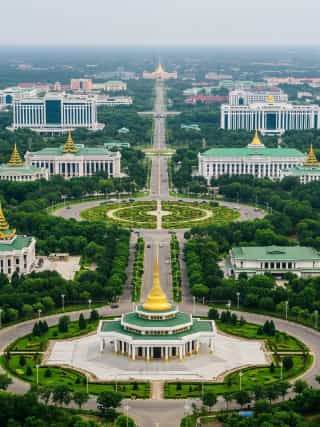
Naypyidaw - The Capital of Myanmar
- Population
- 1,160,242
- Language
- Burmese
- Continent
- Asia
- Since
- 2006
- Eco Ranking
- 177/195
Source: Environmental Performance Index 2024.
About Naypyidaw
Naypyidaw is a purpose-built capital, constructed entirely from scratch in central Myanmar and declared the national capital in November 2005, with the official transfer of government functions completed in 2006. The decision was made by the military junta (SPDC) under Senior General Than Shwe and announced with almost no advance notice. The reasons for the move were never officially explained, but analysts believe the relocation was motivated by strategic considerations, moving the government inland, away from the coast and potential naval bombardment, as well as a desire to distance the military government from Yangon, the former colonial capital and center of civilian opposition. Naypyidaw covers an area larger than London but has a fraction of Yangon's population, and is defined by wide, largely empty eight-lane highways, oversized government buildings, and militarized urban planning. The 2021 military coup, which ousted the elected government of Aung San Suu Kyi, was directed from Naypyidaw. The country has since been engulfed in civil conflict, with resistance forces controlling significant territory. Yangon remains Myanmar's commercial hub and most populous city, with a population more than ten times that of Naypyidaw.
About Myanmar
Myanmar is governed by a military junta, the State Administration Council (SAC), following the February 2021 coup that overthrew the elected National League for Democracy government. Senior General Min Aung Hlaing leads the junta, which has faced armed resistance from an array of ethnic armed organizations and the People's Defence Force, the armed wing of the opposition National Unity Government. The conflict has displaced millions and constitutes one of the most severe humanitarian crises in Asia. The international community has broadly refused to recognize the junta's legitimacy, though practical engagement continues. Myanmar's official capital is Naypyidaw; Yangon remains the economic center.
View Naypyidaw on the map
Flight time from Naypyidaw to other capitals
| City | Distance (km) | Flight Time |
|---|---|---|
| Singapore | 2200 | 2h 35m |
| Abu Dhabi | 4300 | 5h 4m |
| Tokyo | 4600 | 5h 25m |
| Rome | 8000 | 9h 25m |
| Canberra | 8300 | 9h 46m |
| Paris | 8600 | 10h 7m |
| London | 8700 | 10h 14m |
| Cape Town | 10100 | 11h 53m |
| Washington, D.C. | 13500 | 15h 53m |
| Buenos Aires | 17000 | 20h 0m |
Capitals with similar population to Naypyidaw
Capitals with similar eco ranking to Naypyidaw
Source: Environmental Performance Index 2024.
Frequently Asked Questions
Why did Myanmar move its capital to Naypyidaw?
Myanmar's military junta announced the move to Naypyidaw in November 2005 without detailed explanation. Analysts suggest the military sought a more strategically defensible location away from the coast, wanted to reduce the civilian opposition's proximity to government, and may have wished to construct a capital entirely under military design and control. Astrology is also reported to have played a role in the timing of the move.
When did Naypyidaw become the capital of Myanmar?
Naypyidaw was declared the capital in November 2005, with the formal transfer of government functions completed in 2006. The city was constructed from nothing in a previously rural area of Naypyidaw Union Territory in central Myanmar.
Why are Naypyidaw's roads and infrastructure so oversized?
Naypyidaw was built by the military according to its own design principles, which emphasized scale, order, and military utility. The city features eight-lane highways that are largely empty, massive parade grounds, and government buildings set far apart. The layout reflects military planning priorities rather than urban functionality, and the city has not attracted the civilian population needed to fill its infrastructure.
What is the relationship between Naypyidaw and Yangon?
Naypyidaw is Myanmar's official capital and seat of government, where parliament and all government ministries are located. Yangon (formerly Rangoon) remains the country's largest city and commercial center, home to the majority of Myanmar's businesses, population, and international presence. The two cities are around 320 kilometers apart.
What happened to Myanmar's government in 2021?
On February 1, 2021, Myanmar's military seized power in a coup, detaining State Counsellor Aung San Suu Kyi and President Win Myint. The military declared a year-long state of emergency, which has since been repeatedly extended. The coup triggered mass protests and, ultimately, an armed resistance movement. The resulting conflict has caused one of Asia's most serious humanitarian crises.
Sights and landmarks
Climate and best time to visit
Regional significance
Economy