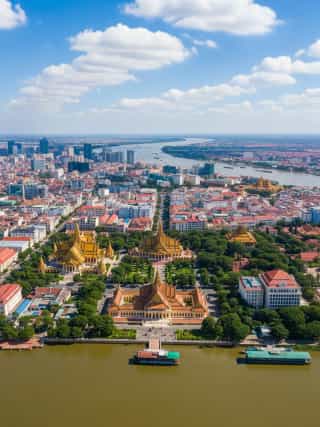
Phnom Penh - The Capital of Cambodia
- Population
- 2,129,371
- Language
- Khmer
- Continent
- Asia
- Since
- 1434
- Eco Ranking
- 170/195
Source: Environmental Performance Index 2024.
About Phnom Penh
Phnom Penh became the permanent capital of Cambodia in 1434, replacing Angkor after the fall of the Khmer Empire to Thai forces. The city's modern history is defined by one of the most devastating events of the 20th century. On April 17, 1975, Khmer Rouge forces captured Phnom Penh and within days ordered the complete forced evacuation of its population, an estimated two million or more people were driven at gunpoint into the countryside to serve as agricultural laborers. The city was left almost entirely empty. This depopulation was part of the Khmer Rouge's radical agrarian ideology under Pol Pot, which sought to abolish urban society, money, and formal education. Between 1975 and 1979, the regime oversaw mass killings, forced labor, and starvation that killed an estimated 1.5 to 2 million people, roughly one quarter of Cambodia's population. Vietnamese military forces expelled the Khmer Rouge in January 1979 and Phnom Penh began to be slowly repopulated. The Extraordinary Chambers in the Courts of Cambodia, a UN-assisted tribunal, prosecuted senior Khmer Rouge leaders from 2007 onward, with final verdicts on genocide charges delivered as late as 2022. Today, Phnom Penh is the seat of Cambodia's government under the ruling Cambodian People's Party, which has governed since 1979.
About Cambodia
Cambodia is a constitutional monarchy governed in practice as a dominant-party state under the Cambodian People's Party, which has held power since the Vietnamese intervention in 1979. Hun Sen served as prime minister for nearly four decades before handing power to his son Hun Manet in 2023. The country is a member of ASEAN and maintains a complex relationship with China, its largest foreign investor and development partner.
View Phnom Penh on the map
Flight time from Phnom Penh to other capitals
| City | Distance (km) | Flight Time |
|---|---|---|
| Singapore | 1100 | 1h 18m |
| Tokyo | 4400 | 5h 11m |
| Abu Dhabi | 5500 | 6h 28m |
| Canberra | 7000 | 8h 14m |
| Rome | 9300 | 10h 56m |
| Paris | 9900 | 11h 39m |
| London | 10000 | 11h 46m |
| Cape Town | 10400 | 12h 14m |
| Washington, D.C. | 14400 | 16h 56m |
| Buenos Aires | 16900 | 19h 53m |
Capitals with similar population to Phnom Penh
Capitals with similar eco ranking to Phnom Penh
Source: Environmental Performance Index 2024.
Frequently Asked Questions
Why did the Khmer Rouge evacuate Phnom Penh?
The Khmer Rouge forcibly evacuated Phnom Penh in April 1975 as part of their ideology of radical agrarian revolution. The regime considered cities to be corrupt capitalist spaces and sought to transform Cambodia into a rural, classless agrarian society. Urban residents were sent to rural labor camps as part of this ideological program.
How many people were killed under the Khmer Rouge?
Estimates of deaths under the Khmer Rouge regime between 1975 and 1979 range from 1.5 to 2 million people, representing approximately one quarter of Cambodia's total population at the time. Deaths resulted from execution, forced labor, starvation, and disease.
When did Phnom Penh become the capital of Cambodia?
Phnom Penh became the permanent capital of Cambodia in 1434, after the Khmer Empire's capital of Angkor was abandoned following repeated Thai invasions. The city's position at the confluence of the Mekong and Tonlé Sap rivers made it strategically and commercially advantageous.
What is the Extraordinary Chambers in the Courts of Cambodia?
The Extraordinary Chambers in the Courts of Cambodia (ECCC) is a UN-assisted tribunal established to prosecute senior Khmer Rouge leaders for crimes against humanity, genocide, and war crimes. It was established by agreement between Cambodia and the UN in 2003 and has issued several convictions, including against former Khmer Rouge president Khieu Samphan.
Who governs Cambodia today?
Cambodia is governed by the Cambodian People's Party, which has held power since 1979. Hun Sen was prime minister for 38 years before handing power to his son, Hun Manet, in August 2023. Cambodia is formally a constitutional monarchy with King Norodom Sihamoni as head of state.
Sights and landmarks
Climate and best time to visit
Economy