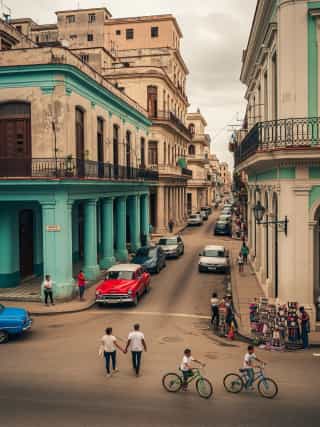
Havana - The Capital of Cuba
- Population
- 2,106,146
- Language
- Spanish
- Continent
- North America
- Since
- 1519
- Eco Ranking
- 49/195
Source: Environmental Performance Index 2024.
About Havana
Havana was founded by Spanish colonizers in 1519 and served as a critical administrative and military hub in Spain's American empire, functioning as the assembly point for the Spanish treasure fleet. It remained under Spanish control until 1898, when Spain lost Cuba following the Spanish-American War, after which Cuba fell under significant US influence, including a period of direct US military occupation and, later, close economic and political ties to Washington. That relationship ended abruptly with the Cuban Revolution of 1959, when Fidel Castro's forces overthrew the US-backed government of Fulgencio Batista. Since 1959, Cuba has been governed as a one-party socialist state, with the Communist Party of Cuba holding constitutional supremacy over all government institutions. Havana serves as the complete seat of power: the National Assembly of People's Power, the Council of State, the Council of Ministers, and the offices of the party leadership are all based there. The US maintained a trade embargo against Cuba from 1962, briefly relaxed under President Obama, then tightened again under subsequent administrations. Havana's built environment reflects this history: Spanish colonial fortifications, early 20th-century American-era architecture, and decades of limited maintenance. Cuba is the only country in the Western Hemisphere governed under a constitutionally mandated one-party system.
About Cuba
Cuba is a one-party socialist republic in the Caribbean governed by the Communist Party of Cuba, which is constitutionally designated as the leading force in society and the state. The president serves as head of state and government. Cuba gained formal independence from Spain in 1898 but experienced extensive US political and economic influence until the 1959 revolution. The country has faced a US trade embargo since 1962. Miguel Díaz-Canel assumed the presidency in 2018, ending the Castro family's direct hold on the office.
View Havana on the map
Flight time from Havana to other capitals
| City | Distance (km) | Flight Time |
|---|---|---|
| Washington, D.C. | 1800 | 2h 7m |
| Buenos Aires | 6900 | 8h 7m |
| London | 7500 | 8h 49m |
| Paris | 7700 | 9h 4m |
| Rome | 8700 | 10h 14m |
| Tokyo | 12100 | 14h 14m |
| Cape Town | 12400 | 14h 35m |
| Abu Dhabi | 13000 | 15h 18m |
| Canberra | 14900 | 17h 32m |
| Singapore | 17200 | 20h 14m |
Capitals with similar population to Havana
| City | Population |
|---|---|
| Brazzaville | 2,230,821 |
| Paris | 2,161,000 |
| Phnom Penh | 2,129,371 |
| Havana | 2,106,146 |
| Damascus | 2,079,000 |
| Minsk | 1,982,444 |
| Panama City | 1,938,000 |
Capitals with similar eco ranking to Havana
| City | Eco Rank |
|---|---|
| Brasília | 47 |
| Singapore | 47 |
| Panama City | 48 |
| Port of Spain | 49 |
| Havana | 49 |
| Abu Dhabi | 51 |
| Harare | 51 |
Source: Environmental Performance Index 2024.
Frequently Asked Questions
Why is Havana the capital of Cuba?
Havana has been Cuba's primary city and administrative center since the Spanish colonial period, when it served as the headquarters of Spanish colonial governance and the assembly point for Atlantic trade fleets. Its political dominance continued through independence and into the post-revolutionary period.
What changed in Havana after the 1959 Cuban Revolution?
The revolution replaced the US-backed government with a socialist administration under Fidel Castro. Foreign businesses, including large American holdings, were nationalized, and Cuba aligned politically with the Soviet Union. The US severed diplomatic relations and imposed a trade embargo in 1962, fundamentally altering Havana's economic and political environment.
How long has Cuba been under one-party rule?
Cuba has been governed by the Communist Party of Cuba as the sole legal political party since the early 1960s following the revolution. The 2019 constitution formally enshrined this arrangement, designating the Communist Party as the superior leading force of society and the state.
Is Havana the largest city in Cuba?
Yes, Havana is by far the largest city in Cuba, with a population of over 2.1 million. It is roughly four times the size of the country's second-largest city, Santiago de Cuba.
What is the relationship between Havana and the United States historically?
From 1898 to 1959, the US exercised significant influence over Cuba, including direct military occupation (1898-1902 and 1906-1909) and extensive economic interests. After the 1959 revolution, relations deteriorated sharply. The US imposed a trade embargo in 1962 and severed diplomatic ties, which were briefly restored under President Obama before being curtailed again.
Sights and landmarks
Climate and best time to visit
Culture and customs
Economy