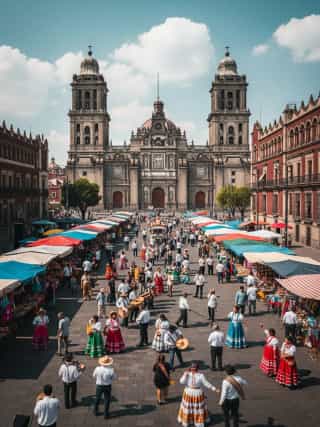
Mexico City - The Capital of Mexico
- Population
- 9,209,944
- Language
- Spanish
- Continent
- North America
- Since
- 1325
- Eco Ranking
- 98/195
Source: Environmental Performance Index 2024.
Bekijk deze video over Mexico City, de prachtige hoofdstad van Mexico
About Mexico City
Mexico City stands on the site of Tenochtitlan, the capital of the Aztec Empire, founded in 1325 on an island in Lake Texcoco. Spanish conquistadors under Hernán Cortés destroyed Tenochtitlan in 1521 after a prolonged siege and built a new colonial capital directly on its ruins. For three centuries it was the seat of the Viceroyalty of New Spain, one of the most powerful colonial administrative units in history. When Mexico achieved independence in 1821, the city became the national capital. The city sits on a drained lake bed, which causes it to sink at rates of up to 50 centimeters per year in some areas, one of the most severe cases of urban subsidence globally, with direct consequences for infrastructure and building stability. Mexico City is a Federal Entity with its own government, distinct from the surrounding State of Mexico. It houses the executive, legislative, and judicial branches of the federal government, including the National Palace on the Zócalo, the main square built over the ruins of the Aztec royal palace. Mexico City is the most populous city in North America.
About Mexico
Mexico is a federal republic comprising 31 states and one Federal Entity, Mexico City. The president, elected every six years without the possibility of re-election, holds executive power and governs from the National Palace in Mexico City. The 1917 Constitution, drafted in the aftermath of the Mexican Revolution, established the current federal structure and remains in force today, though significantly amended. Mexico is a member of the G20 and USMCA (the successor to NAFTA). The country's political landscape shifted significantly in 2018 when Andrés Manuel López Obrador was elected on a left-wing platform, ending decades of dominance by the PRI and PAN parties.
View Mexico City on the map
Flight time from Mexico City to other capitals
| City | Distance (km) | Flight Time |
|---|---|---|
| Washington, D.C. | 3000 | 3h 32m |
| Buenos Aires | 7400 | 8h 42m |
| London | 8900 | 10h 28m |
| Paris | 9200 | 10h 49m |
| Rome | 10200 | 12h 0m |
| Tokyo | 11300 | 13h 18m |
| Canberra | 13200 | 15h 32m |
| Cape Town | 13700 | 16h 7m |
| Abu Dhabi | 14400 | 16h 56m |
| Singapore | 16600 | 19h 32m |
Capitals with similar population to Mexico City
Capitals with similar eco ranking to Mexico City
| City | Eco Rank |
|---|---|
| Port Vila | 95 |
| Kuwait City | 96 |
| South Tarawa | 97 |
| Mexico City | 98 |
| Montevideo | 99 |
| Windhoek | 100 |
| Dakar | 101 |
Source: Environmental Performance Index 2024.
Frequently Asked Questions
Why is Mexico City built on a lake?
Mexico City was built by Spanish colonizers on the ruins of Tenochtitlan, the Aztec capital, which was itself constructed on an island in Lake Texcoco. The Spanish drained much of the lake and built over it. The city now sits on unstable, water-saturated clay, which causes it to sink continuously, a process known as subsidence.
When did Mexico City become the capital of Mexico?
Mexico City became the capital of independent Mexico in 1821, following the conclusion of the Mexican War of Independence. Before that, it served as the capital of the Viceroyalty of New Spain from 1521. The city had been the Aztec capital of Tenochtitlan since its founding in 1325.
Is Mexico City a state?
No. Mexico City is a Federal Entity (Ciudad de México, or CDMX), distinct from Mexico's 31 states. It has its own elected government, head of government (a position equivalent to governor), and local legislature. Before a 2016 constitutional reform, it was known as the Federal District (Distrito Federal).
Is Mexico City the largest city in Mexico?
Yes. Mexico City is by far the largest city in Mexico and in North America. The city proper has a population of around 9.2 million, but the greater metropolitan area, one of the largest in the world, is home to over 21 million people.
What is the Zócalo in Mexico City?
The Zócalo (formally the Plaza de la Constitución) is Mexico City's main public square and one of the largest in the world. It has been the political center of the city since Aztec times, the National Palace, the seat of the federal executive, stands on its eastern side, built over the ruins of the palace of the Aztec emperor Moctezuma.
Sights and landmarks
Climate and best time to visit
Culture and customs
Economy