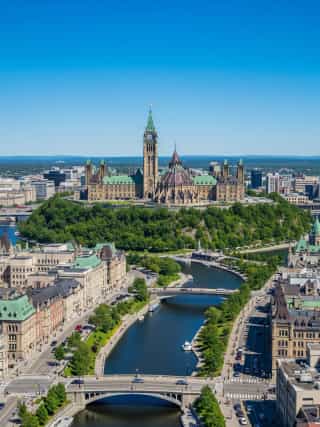
Ottawa - The Capital of Canada
- Population
- 1,017,449
- Language
- English
- Continent
- North America
- Since
- 1857
- Eco Ranking
- 28/195
Source: Environmental Performance Index 2024.
About Ottawa
Ottawa's selection as Canada's capital was a deliberate political compromise. When the Province of Canada was debating a permanent capital in the 1850s, Toronto and Montreal were both strong candidates, but each sat firmly within either English-speaking Ontario or French-speaking Quebec, making either choice politically divisive. Queen Victoria made the final decision in 1857, selecting Bytown, renamed Ottawa that same year, a city that straddled the Ontario-Quebec border and was far enough from the American frontier to be militarily defensible. Ottawa became the capital of the Dominion of Canada at Confederation in 1867. Parliament Hill, the home of the Senate and the House of Commons, sits directly on a bluff above the Ottawa River. The city is also home to Rideau Hall, the official residence of the Governor General, who represents the Crown. As a bilingual federal capital, Ottawa operates equally in English and French, a legal requirement. Government institutions, the Supreme Court of Canada, and the headquarters of all federal departments are concentrated here. Across the river lies Gatineau, Quebec, where several federal departments are also located, reinforcing the capital region's dual-province character.
About Canada
Canada is a federal parliamentary constitutional monarchy with ten provinces and three territories. The federal Parliament consists of an elected House of Commons and an appointed Senate. Executive power is exercised by the prime minister and cabinet. Canada's constitutional monarchy means the British monarch serves as head of state, represented federally by the Governor General.
View Ottawa on the map
Flight time from Ottawa to other capitals
| City | Distance (km) | Flight Time |
|---|---|---|
| Washington, D.C. | 700 | 0h 49m |
| London | 5400 | 6h 21m |
| Paris | 5600 | 6h 35m |
| Rome | 6700 | 7h 53m |
| Buenos Aires | 9100 | 10h 42m |
| Tokyo | 10300 | 12h 7m |
| Abu Dhabi | 10800 | 12h 42m |
| Cape Town | 12900 | 15h 11m |
| Singapore | 14800 | 17h 25m |
| Canberra | 16100 | 18h 56m |
Capitals with similar population to Ottawa
Capitals with similar eco ranking to Ottawa
Source: Environmental Performance Index 2024.
Frequently Asked Questions
Why is Ottawa the capital of Canada and not Toronto or Montreal?
Ottawa was chosen as a compromise in 1857 by Queen Victoria. Toronto and Montreal were both considered, but each was seen as too closely aligned with either English or French Canada. Ottawa sat on the border of Ontario and Quebec, was defensible from potential US incursion, and was acceptable to both linguistic communities.
When did Ottawa become the capital of Canada?
Ottawa was designated the capital of the Province of Canada in 1857. It became the capital of the Dominion of Canada when Confederation took effect on July 1, 1867, a status it has held ever since.
Is Ottawa the largest city in Canada?
No. Ottawa is the fourth-largest city in Canada. Toronto, Montreal, and Vancouver are all larger. Ottawa's population is approximately 1 million, compared to Toronto's metropolitan area of over 6 million.
Why does Canada have a bilingual capital?
Ottawa operates in both English and French because Canada's federal government is constitutionally required to function in both official languages. Ottawa's location on the Ontario-Quebec border reinforces this: the adjacent city of Gatineau, Quebec, is home to many federal employees and several government departments.
Where does the Canadian Parliament meet?
The Canadian Parliament meets on Parliament Hill in Ottawa, overlooking the Ottawa River. The complex houses the Senate, the House of Commons, and the offices of the Prime Minister and parliamentary leaders. The Centre Block, including the Peace Tower, is the iconic centrepiece of the site.
Sights and landmarks
Climate and best time to visit
Regional significance