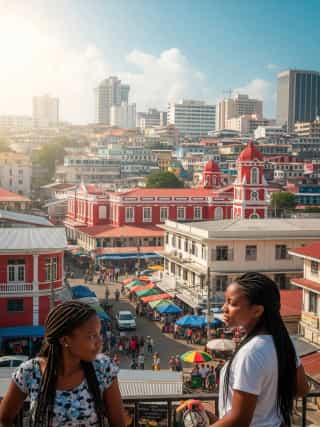
Port of Spain - The Capital of Trinidad and Tobago
- Population
- 37,074
- Language
- English
- Continent
- North America
- Since
- 1757
- Eco Ranking
- 49/195
Source: Environmental Performance Index 2024.
About Port of Spain
Port of Spain has been a center of Caribbean political and commercial life since it became the capital of the British colony of Trinidad in 1757. The island of Trinidad was a Spanish colony from the late 15th century until British forces captured it in 1797, and Port of Spain transitioned to the administrative center of British colonial government. Trinidad and Tobago gained independence on August 31, 1962, and became a republic within the Commonwealth in 1976. Port of Spain functions as the seat of the bicameral Parliament, the Office of the President, and the governmental ministries of the twin-island state. Trinidad and Tobago has one of the highest per capita incomes in the Caribbean, driven by substantial oil and natural gas reserves, particularly offshore in the Gulf of Paria and through LNG facilities that make it a significant regional energy exporter. The country's relative wealth has shaped its political independence from aid dependency, though fluctuating energy prices create fiscal volatility. Port of Spain is the administrative and financial capital; Tobago has its own House of Assembly with significant autonomy. Trinidad has been the site of two attempted coups: the 1970 Black Power Revolt and the 1990 attempted coup by the Jamaat al Muslimeen, which briefly seized the parliament building and held the prime minister hostage.
About Trinidad and Tobago
Trinidad and Tobago is a parliamentary republic within the Commonwealth. The bicameral Parliament consists of an elected House of Representatives and an appointed Senate. Executive power is exercised by the prime minister, while the president holds a largely ceremonial role. Tobago has a degree of internal self-government through its House of Assembly. The country is a significant Caribbean energy producer.
View Port of Spain on the map
Flight time from Port of Spain to other capitals
| City | Distance (km) | Flight Time |
|---|---|---|
| Washington, D.C. | 3500 | 4h 7m |
| Buenos Aires | 5000 | 5h 53m |
| London | 7100 | 8h 21m |
| Paris | 7200 | 8h 28m |
| Rome | 7900 | 9h 18m |
| Cape Town | 9800 | 11h 32m |
| Abu Dhabi | 12000 | 14h 7m |
| Tokyo | 14400 | 16h 56m |
| Canberra | 15900 | 18h 42m |
| Singapore | 17900 | 21h 4m |
Capitals with similar population to Port of Spain
Capitals with similar eco ranking to Port of Spain
Source: Environmental Performance Index 2024.
Frequently Asked Questions
When did Trinidad and Tobago gain independence?
Trinidad and Tobago gained independence from Britain on August 31, 1962. The country became a republic on August 1, 1976, replacing the Queen with a President as head of state while remaining within the Commonwealth.
Why is Trinidad and Tobago relatively wealthy compared to other Caribbean nations?
Trinidad and Tobago has significant petroleum and natural gas reserves, which have provided government revenues and foreign exchange that other Caribbean island economies lack. The country is the Caribbean's leading energy producer and exports LNG to multiple continents, supporting a higher GDP per capita than most regional neighbors.
What was the 1990 coup attempt in Trinidad and Tobago?
On July 27, 1990, a militant Islamic group called the Jamaat al Muslimeen, led by Yasin Abu Bakr, stormed the parliament building in Port of Spain and took Prime Minister A.N.R. Robinson and other officials hostage. The group also seized the state television station. The attempted coup lasted six days before the militants surrendered in exchange for an amnesty, which was later overturned by the courts.
Is Port of Spain the largest city in Trinidad and Tobago?
Port of Spain is the capital but not the most populous municipality; the city proper has a relatively small population of around 37,000. However, the greater Port of Spain metropolitan area is significantly larger. San Fernando is the second-largest urban center, and large residential areas surround Port of Spain in what is referred to as the East-West Corridor.
What is the relationship between Trinidad and Tobago?
Trinidad and Tobago are two separate islands that were joined as a single British colony in 1889 and became one independent state in 1962. Tobago has its own House of Assembly with devolved authority over internal matters. The two islands differ significantly in size, economy, and culture, and there has been periodic political debate about the degree of Tobago's autonomy.
Sights and landmarks
Climate and best time to visit
Culture and customs
Economy