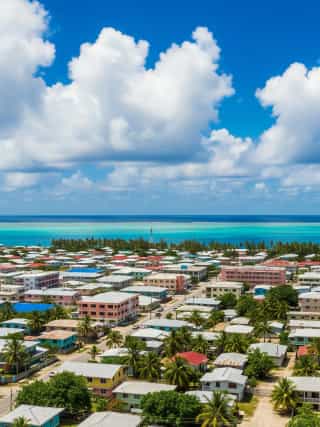
Majuro - The Capital of Marshall Islands
- Population
- 28,000
- Language
- English
- Continent
- Oceania
- Since
- 1979
- Eco Ranking
- 110/195
Source: Environmental Performance Index 2024.
About Majuro
Majuro is the capital and largest atoll of the Marshall Islands, serving as the seat of government since the country adopted its constitution in 1979 and entered into a Compact of Free Association with the United States. The Marshall Islands were administered by the United States under a UN trusteeship following World War II, during which the islands had been seized from Japan. Between 1946 and 1958, the United States conducted 67 nuclear weapons tests at Bikini and Enewetak atolls in the Marshall Islands, including the largest US nuclear test ever, Castle Bravo (1954), which was far more powerful than anticipated and contaminated inhabited islands and a Japanese fishing vessel. The nuclear testing legacy remains unresolved: affected islanders have never been fully compensated or resettled. Majuro sits at an average elevation of roughly two meters above sea level, making it acutely vulnerable to the effects of climate change and sea-level rise. The Marshallese government has been one of the most vocal advocates for aggressive global climate action, arguing the country faces existential threat. The Compact of Free Association grants Marshallese citizens the right to live and work in the United States. Majuro hosts the largest tuna transshipment port in the Pacific region.
About Marshall Islands
The Marshall Islands is a sovereign Micronesian nation in the central Pacific, comprising 29 atolls and 5 islands. It was a German colony until World War I, then a Japanese-administered League of Nations mandate, and then a US trust territory until 1986. The Compact of Free Association with the United States means the US provides defense and financial assistance in exchange for military access rights. The country is among those most existentially threatened by sea-level rise. It is a member of the United Nations and the Pacific Islands Forum.
View Majuro on the map
Flight time from Majuro to other capitals
| City | Distance (km) | Flight Time |
|---|---|---|
| Tokyo | 4500 | 5h 18m |
| Canberra | 5300 | 6h 14m |
| Singapore | 7500 | 8h 49m |
| Washington, D.C. | 11300 | 13h 18m |
| Abu Dhabi | 12300 | 14h 28m |
| London | 13400 | 15h 46m |
| Paris | 13700 | 16h 7m |
| Buenos Aires | 14100 | 16h 35m |
| Rome | 14100 | 16h 35m |
| Cape Town | 15900 | 18h 42m |
Capitals with similar population to Majuro
| City | Population |
|---|---|
| Banjul | 31,301 |
| Majuro | 28,000 |
| Victoria | 26,450 |
| Nuku'alofa | 23,658 |
| Andorra la Vella | 22,886 |
| St. John's | 22,219 |
| Castries | 22,000 |
Capitals with similar eco ranking to Majuro
Source: Environmental Performance Index 2024.
Frequently Asked Questions
When did Majuro become the capital of the Marshall Islands?
Majuro became the capital when the Marshall Islands adopted its constitution on 1 May 1979 and formally established a self-governing republic. The country entered into a Compact of Free Association with the United States, which came into effect on 21 October 1986, when the Marshall Islands became fully self-governing in association with the US.
What was the impact of US nuclear testing on the Marshall Islands?
Between 1946 and 1958, the United States detonated 67 nuclear devices at Bikini and Enewetak atolls, including the 15-megaton Castle Bravo test in 1954, which was approximately 1,000 times more powerful than the Hiroshima bomb. Fallout contaminated inhabited atolls and forced permanent displacement of communities. Many Bikinian islanders have never been able to return. The United States established a Nuclear Claims Tribunal that awarded over $2 billion in damages, but this amount has never been fully paid.
Why is Majuro considered threatened by climate change?
Majuro and most of the Marshall Islands atolls sit at an average elevation of only one to two meters above sea level. Projections of sea-level rise, even at conservative estimates, threaten to inundate significant portions of the islands by the end of the 21st century. Saltwater intrusion is already affecting freshwater supplies and agricultural land. The Marshall Islands government has argued the country faces national survival as a territory.
What is the Compact of Free Association?
The Compact of Free Association is a political arrangement between the United States and the Marshall Islands (and separately, Palau and the Federated States of Micronesia) under which the US provides financial assistance and assumes responsibility for defense, while the Marshall Islands operates as a fully sovereign state. Marshallese citizens may live, work, and serve in the US military without a visa. The compact was renewed and renegotiated in 2023.
Is Majuro the largest settlement in the Marshall Islands?
Yes, Majuro Atoll is home to the majority of the Marshall Islands' total population of roughly 42,000 people, with approximately 28,000 living in the Majuro urban area. Ebeye on Kwajalein Atoll is the second-largest settlement. The extreme concentration of population on Majuro reflects both its capital status and the ongoing migration of outer atoll residents toward the capital.
Sights and landmarks
Climate and best time to visit
Regional significance
Economy