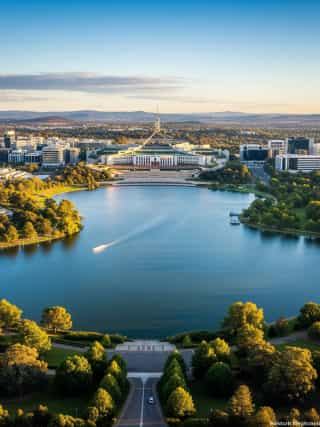
Canberra - The Capital of Australia
- Population
- 431,380
- Language
- English
- Continent
- Oceania
- Since
- 1913
- Eco Ranking
- 23/195
Source: Environmental Performance Index 2024.
About Canberra
Canberra is a purpose-built capital, selected as a political compromise after Australian federation in 1901. Sydney and Melbourne each refused to cede the capital to the other, so the Australian Constitution required the capital to be located in New South Wales but at least 100 miles from Sydney. A site in the Limestone Plains region was selected in 1908, and the city was formally named Canberra in 1913. American architects Walter Burley Griffin and Marion Mahony Griffin won the international design competition for the city's layout. Parliament sat in Melbourne until the provisional Parliament House in Canberra opened in 1927. The permanent Parliament House on Capital Hill opened in 1988. Canberra is situated within the Australian Capital Territory (ACT), a federal territory carved out of New South Wales, giving the national government direct jurisdiction over the capital, a model explicitly borrowed from the American experience with Washington D.C. Despite being the seat of federal government, Canberra is not Australia's largest or most commercially significant city, a tension that has persisted in Australian political culture since federation.
About Australia
Australia is a federal parliamentary constitutional monarchy, with the British monarch as head of state represented by the Governor-General. The Parliament consists of the Senate and the House of Representatives. Six states and two major territories (including the ACT) make up the federation. The division of powers between the federal government in Canberra and state governments has been a defining feature of Australian politics, with the Commonwealth's financial dominance over the states increasing significantly since World War II.
View Canberra on the map
Flight time from Canberra to other capitals
| City | Distance (km) | Flight Time |
|---|---|---|
| Singapore | 6200 | 7h 18m |
| Tokyo | 8000 | 9h 25m |
| Cape Town | 10800 | 12h 42m |
| Buenos Aires | 11700 | 13h 46m |
| Abu Dhabi | 12000 | 14h 7m |
| Washington, D.C. | 15900 | 18h 42m |
| Rome | 16200 | 19h 4m |
| Paris | 16900 | 19h 53m |
| London | 17000 | 20h 0m |
Capitals with similar population to Canberra
Capitals with similar eco ranking to Canberra
Source: Environmental Performance Index 2024.
Frequently Asked Questions
Why was Canberra chosen as Australia's capital instead of Sydney or Melbourne?
After federation in 1901, both Sydney and Melbourne claimed the right to be the national capital. The compromise written into the Australian Constitution required the capital to be in New South Wales but at least 100 miles from Sydney. The Canberra site was selected in 1908 as a neutral location acceptable to both rival cities.
When did Canberra become Australia's capital?
Canberra was formally named in 1913, but the federal parliament continued to sit in Melbourne until 1927, when the provisional Parliament House in Canberra opened. The permanent Parliament House was not opened until 1988.
Is Canberra located in New South Wales?
Canberra is located within the Australian Capital Territory (ACT), which is a separate federal territory, not part of New South Wales. However, the ACT is surrounded by New South Wales on all sides, and the site was originally carved out of NSW to satisfy the constitutional requirement.
Is Canberra the largest city in Australia?
No. Canberra has a population of approximately 430,000, making it the largest inland city in Australia but far smaller than Sydney (over 5 million) and Melbourne (over 5 million). It is the eighth-largest city overall.
Who designed Canberra?
The city's layout was designed by American architects Walter Burley Griffin and Marion Mahony Griffin, who won an international design competition in 1911. Their plan featured a geometric layout centered on a land axis and a water axis, with Lake Burley Griffin, named after the architect, as a central feature.
Sights and landmarks
Climate and best time to visit
Regional significance
Culture and customs
Economy