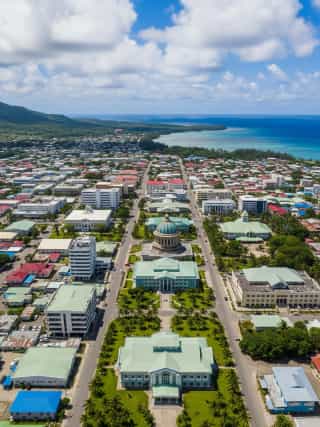
Palikir - The Capital of Micronesia
- Population
- 6,647
- Language
- English
- Continent
- Oceania
- Since
- 1989
- Eco Ranking
- 119/195
Source: Environmental Performance Index 2024.
About Palikir
Palikir became the capital of the Federated States of Micronesia in 1989, replacing the town of Kolonia on the island of Pohnpei. It is one of the world's smallest capitals by population, with fewer than 7,000 residents, and consists primarily of government buildings set in a valley on Pohnpei island. Micronesia came under US administration as part of the Trust Territory of the Pacific Islands after World War II, having previously been a Japanese mandate under the League of Nations. The country adopted a constitution and entered into a Compact of Free Association with the United States in 1986, under which the US retains full authority over Micronesia's defense and provides substantial financial assistance. This compact has been periodically renegotiated; an amended agreement was signed in 2023. The Federated States consists of four states, Yap, Chuuk, Pohnpei, and Kosrae, spread across the western Pacific. The national government in Palikir holds limited authority over these largely autonomous states. Micronesia's geopolitical position has grown more significant with increased competition between the US and China in the Pacific, as Palikir must navigate its treaty obligations while maintaining diplomatic relationships across the region. Micronesia faces an existential threat from sea-level rise, which shapes much of its international advocacy.
About Micronesia
The Federated States of Micronesia is a federal republic in the western Pacific governed under a constitution modeled partly on the US system. Congress consists of fourteen senators, one four-year senator per state and thirteen one-year senators. The country is in a Compact of Free Association with the United States, which provides defense and significant budget support. Citizens may live and work freely in the United States.
View Palikir on the map
Flight time from Palikir to other capitals
| City | Distance (km) | Flight Time |
|---|---|---|
| Tokyo | 3700 | 4h 21m |
| Canberra | 4800 | 5h 39m |
| Singapore | 6100 | 7h 11m |
| Abu Dhabi | 11100 | 13h 4m |
| Washington, D.C. | 12400 | 14h 35m |
| London | 13200 | 15h 32m |
| Paris | 13400 | 15h 46m |
| Rome | 13600 | 16h 0m |
| Cape Town | 14900 | 17h 32m |
| Buenos Aires | 15200 | 17h 53m |
Capitals with similar population to Palikir
| City | Population |
|---|---|
| St. George's | 7,500 |
| Palikir | 6,647 |
| Valletta | 6,444 |
| Funafuti | 6,320 |
| Vaduz | 5,696 |
| San Marino | 4,061 |
| Yaren | 1,100 |
Capitals with similar eco ranking to Palikir
| City | Eco Rank |
|---|---|
| Ciudad de la Paz | 115 |
| Brazzaville | 116 |
| San Salvador | 117 |
| Kuala Lumpur | 118 |
| Palikir | 119 |
| Ashgabat | 120 |
| Baku | 121 |
Source: Environmental Performance Index 2024.
Frequently Asked Questions
Why is Palikir the capital of Micronesia?
Palikir was selected as the capital to provide a purpose-built seat of government separate from the existing population center of Kolonia. It was developed in the late 1980s on Pohnpei island and formally designated the capital in 1989 when the new government complex was completed.
What is the Compact of Free Association between Micronesia and the US?
The Compact of Free Association, in effect since 1986, grants the United States full authority over Micronesia's defense and military operations in exchange for financial assistance and the right of Micronesian citizens to live and work in the US. The arrangement makes Micronesia a sovereign state but outsources its security to the US.
Was Micronesia ever a Japanese territory?
Yes. After World War I, the League of Nations placed Micronesia under Japanese administration as a mandated territory. Japan administered the islands until its defeat in World War II, after which the United States took over administration under a UN Trusteeship.
How many states does the Federated States of Micronesia have?
Micronesia consists of four states: Yap, Chuuk, Pohnpei, and Kosrae. Each state has its own government and significant autonomy. The national capital, Palikir, is located in Pohnpei state.
Is Palikir the smallest capital city in the world?
Palikir is one of the smallest capital cities in the world by population, with approximately 6,600 residents. It is among a handful of Pacific capitals, alongside Ngerulmud in Palau and Funafuti in Tuvalu, that rank among the least populous capital cities globally.
Sights and landmarks
Climate and best time to visit
Regional significance
Culture and customs
Economy