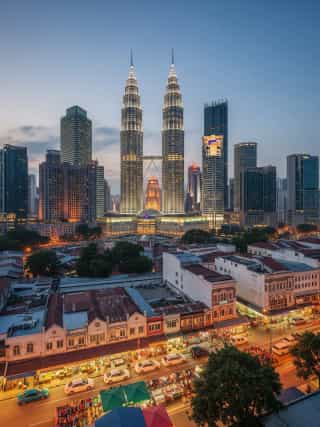
Kuala Lumpur - The Capital of Malaysia
- Population
- 1,808,000
- Language
- Malay
- Continent
- Asia
- Since
- 1957
- Eco Ranking
- 118/195
Source: Environmental Performance Index 2024.
About Kuala Lumpur
Kuala Lumpur became the capital of Malaya at independence in 1957 and retained that status when Malaysia was formed in 1963. Founded in the 1850s as a tin-mining settlement at the confluence of the Klang and Gombak rivers, it grew under British colonial administration into the country's administrative and commercial center. Malaysia has a split capital arrangement: while Kuala Lumpur remains the official capital and the seat of Parliament, the federal government relocated most of its operations to Putrajaya, a purpose-built administrative city roughly 25 kilometers to the south, in 1999. The prime minister's office and the majority of federal ministries now operate from Putrajaya. Kuala Lumpur nonetheless retains symbolic primacy: it hosts the Yang di-Pertuan Agong (the constitutional monarch), Parliament, and the federal judiciary. Malaysia's political system is a constitutional monarchy with a federal parliamentary structure, and the king rotates among nine hereditary state rulers on a five-year cycle. Kuala Lumpur is the only capital city in the world served by a dedicated federal administrative twin.
About Malaysia
Malaysia is a federal constitutional monarchy composed of thirteen states and three federal territories, including Kuala Lumpur itself. The national parliament consists of a Senate and a House of Representatives. Political power since independence has been dominated by coalition governments, most notably Barisan Nasional, though 2018 saw the first transfer of power to an opposition coalition in Malaysian history. The country's unique rotating monarchy, where the king is elected from among nine hereditary sultans every five years, has no direct parallel in any other constitutional system.
View Kuala Lumpur on the map
Flight time from Kuala Lumpur to other capitals
| City | Distance (km) | Flight Time |
|---|---|---|
| Singapore | 300 | 0h 21m |
| Tokyo | 5300 | 6h 14m |
| Abu Dhabi | 5600 | 6h 35m |
| Canberra | 6500 | 7h 39m |
| Cape Town | 9600 | 11h 18m |
| Rome | 9700 | 11h 25m |
| Paris | 10400 | 12h 14m |
| London | 10500 | 12h 21m |
| Washington, D.C. | 15300 | 18h 0m |
| Buenos Aires | 16000 | 18h 49m |
Capitals with similar population to Kuala Lumpur
Capitals with similar eco ranking to Kuala Lumpur
| City | Eco Rank |
|---|---|
| Ciudad de la Paz | 115 |
| Brazzaville | 116 |
| San Salvador | 117 |
| Kuala Lumpur | 118 |
| Palikir | 119 |
| Ashgabat | 120 |
| Baku | 121 |
Source: Environmental Performance Index 2024.
Frequently Asked Questions
Why does Malaysia have two capitals?
Malaysia does not have two official capitals, but it has a functional split: Kuala Lumpur is the official capital and seat of Parliament, while Putrajaya serves as the federal administrative capital where most ministries and the prime minister's office are based. Putrajaya was purpose-built beginning in the 1990s to relieve congestion in Kuala Lumpur.
When did Kuala Lumpur become the capital of Malaysia?
Kuala Lumpur became the capital of the Federation of Malaya at independence from Britain on 31 August 1957. It retained that status when Malaysia was formally established on 16 September 1963, incorporating Singapore (until 1965), Sabah, and Sarawak.
Is Kuala Lumpur the largest city in Malaysia?
Yes, Kuala Lumpur is Malaysia's largest city by population, with roughly 1.8 million residents in the city proper and a significantly larger figure in the greater Klang Valley metropolitan area. It is also the country's main economic and financial center.
Where does the Malaysian Parliament sit?
The Malaysian Parliament sits in Kuala Lumpur, not in Putrajaya. The Parliament House (Bangunan Parlimen) in Kuala Lumpur is the seat of the Dewan Negara (Senate) and Dewan Rakyat (House of Representatives).
What is the political status of Kuala Lumpur within Malaysia?
Kuala Lumpur is one of Malaysia's three federal territories, administered directly by the federal government rather than by a state government. It was granted federal territory status on 1 February 1974, separating it from the state of Selangor that surrounds it.
Sights and landmarks
Climate and best time to visit
Culture and customs