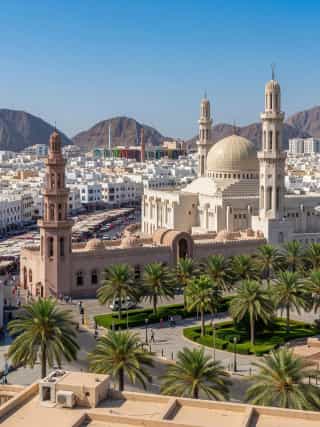
Muscat - The Capital of Oman
- Population
- 1,560,330
- Language
- Arabic
- Continent
- Asia
- Since
- 1970
- Eco Ranking
- 52/195
Source: Environmental Performance Index 2024.
About Muscat
Muscat has served as a significant port and political center on the Arabian Peninsula for centuries, controlled at various times by the Portuguese, the Persian Empire, and the Omani sultans. It became the effective national capital of modern Oman in 1970, when Sultan Qaboos bin Said overthrew his father, Said bin Taimur, in a palace coup and launched a comprehensive modernization program. At the time of the coup, Oman had fewer than 10 kilometers of paved road, no public schools for girls, and no television. Over his 50-year reign, Qaboos transformed Oman into a modern state while maintaining an absolute monarchy. Muscat houses the Royal Palace (Al Alam Palace), the Council of Oman (the bicameral consultative body), and all major government ministries. Oman has pursued a foreign policy of neutrality, maintaining relations with Iran, Israel, and Western powers simultaneously, making Muscat an occasional venue for diplomatic back-channel negotiations. Sultan Qaboos, who died in January 2020 without an heir, was succeeded by his cousin Haitham bin Tariq. Muscat is located on the Gulf of Oman and is one of the most geographically dispersed capital cities in the world, spread across a rugged coastal landscape.
About Oman
Oman is an absolute monarchy governed by Sultan Haitham bin Tariq since 2020. The Basic Law of 1996, Oman's nearest equivalent to a constitution, vests all legislative, executive, and judicial authority in the sultan. The Council of Oman consists of an appointed upper chamber (the Council of State) and a partially elected lower chamber (the Consultative Assembly), but neither has legislative power in the Western sense. Oman is a member of the Gulf Cooperation Council (GCC) and is notable for its policy of political neutrality, maintaining open relations with states that are adversaries of each other, including Iran and the United States.
View Muscat on the map
Flight time from Muscat to other capitals
| City | Distance (km) | Flight Time |
|---|---|---|
| Abu Dhabi | 400 | 0h 28m |
| Rome | 4700 | 5h 32m |
| Singapore | 5500 | 6h 28m |
| Paris | 5600 | 6h 35m |
| London | 5800 | 6h 49m |
| Cape Town | 7700 | 9h 4m |
| Tokyo | 7800 | 9h 11m |
| Canberra | 11600 | 13h 39m |
| Washington, D.C. | 11700 | 13h 46m |
| Buenos Aires | 13900 | 16h 21m |
Capitals with similar population to Muscat
Capitals with similar eco ranking to Muscat
Source: Environmental Performance Index 2024.
Frequently Asked Questions
When did Muscat become the capital of Oman?
Muscat became the effective capital of modern Oman in 1970, when Sultan Qaboos came to power and began the country's rapid modernization. Muscat had historically been the center of Omani rule, but Oman as a unified modern state effectively dates from 1970.
How did Sultan Qaboos come to power?
Sultan Qaboos overthrew his father, Sultan Said bin Taimur, in a palace coup on July 23, 1970, with British support. His father had kept Oman in a state of extreme isolation and underdevelopment. Qaboos immediately began a modernization program, using oil revenues to build infrastructure, schools, hospitals, and a modern state administration.
Why is Oman considered a neutral state?
Oman has deliberately maintained diplomatic relations with all major regional and international actors, including Iran, Israel, and Western powers, a rare posture in the Gulf region. This neutrality has made Muscat a useful location for diplomatic back-channel communications, including talks that preceded the 2015 Iran nuclear deal (JCPOA).
Who succeeded Sultan Qaboos?
Sultan Qaboos bin Said died on January 10, 2020, after ruling for 50 years. He had no children. His cousin Haitham bin Tariq Al Said was selected by the Royal Family Council and confirmed by the Defense Council as his successor. Sultan Haitham has indicated continuity with Qaboos's policies.
Is Muscat the largest city in Oman?
Yes. Muscat is the largest urban agglomeration in Oman, with a metropolitan population of over 1.5 million. It is the country's political, commercial, and administrative center. Oman's other significant cities, including Salalah and Sohar, are considerably smaller.
Sights and landmarks
Climate and best time to visit
Regional significance
Economy