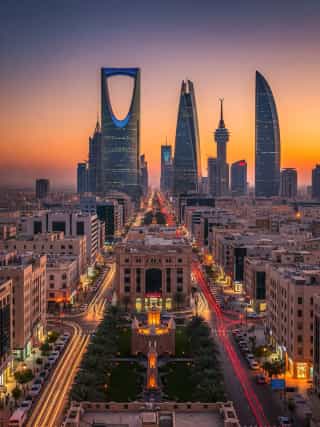
Riyadh - The Capital of Saudi Arabia
- Population
- 7,676,654
- Language
- Arabic
- Continent
- Asia
- Since
- 1932
- Eco Ranking
- 110/195
Source: Environmental Performance Index 2024.
About Riyadh
Riyadh's rise to capital status is inseparable from the political unification of the Arabian Peninsula by Ibn Saud. Having recaptured Riyadh from the rival Al Rashid clan in 1902, Ibn Saud spent the next three decades consolidating control over the Hejaz, Nejd, and other territories through military conquest and political alliance. The Kingdom of Saudi Arabia was formally proclaimed on 23 September 1932, with Riyadh as its capital and Nejd heartland of the Al Saud dynasty. The city houses the royal court, the Council of Ministers, and the Consultative Assembly (Majlis al-Shura). Saudi Arabia is an absolute monarchy governed under Islamic law (Sharia), with the king serving simultaneously as head of state, head of government, and the supreme religious authority as Custodian of the Two Holy Mosques. Riyadh has expanded from a walled mud-brick city of fewer than 30,000 in 1932 to a metropolis of over 7.6 million, one of the fastest urban expansions in history, driven by oil revenues.
About Saudi Arabia
Saudi Arabia is an absolute monarchy with no elected legislature, political parties, or formal constitution separate from the Quran and Sunna. The country holds the world's second largest proven oil reserves and is the dominant power in the Gulf Cooperation Council. Vision 2030, the reform programme launched under Crown Prince Mohammed bin Salman, aims to diversify the economy away from oil dependency.
View Riyadh on the map
Flight time from Riyadh to other capitals
| City | Distance (km) | Flight Time |
|---|---|---|
| Abu Dhabi | 800 | 0h 56m |
| Rome | 3700 | 4h 21m |
| Paris | 4700 | 5h 32m |
| London | 4900 | 5h 46m |
| Singapore | 6700 | 7h 53m |
| Cape Town | 7200 | 8h 28m |
| Tokyo | 8700 | 10h 14m |
| Washington, D.C. | 10800 | 12h 42m |
| Canberra | 12600 | 14h 49m |
| Buenos Aires | 12900 | 15h 11m |
Capitals with similar population to Riyadh
Capitals with similar eco ranking to Riyadh
Source: Environmental Performance Index 2024.
Frequently Asked Questions
Why is Riyadh the capital of Saudi Arabia?
Riyadh is the ancestral home of the Al Saud dynasty and the political centre from which Ibn Saud launched the unification of Arabia. When the Kingdom of Saudi Arabia was proclaimed in 1932, Riyadh's status as the seat of Al Saud power made it the natural capital. It has remained the seat of all central government institutions since the kingdom's founding.
When did Riyadh become the capital of Saudi Arabia?
Riyadh became the capital when the Kingdom of Saudi Arabia was formally established on 23 September 1932. The date is celebrated as Saudi National Day. Ibn Saud had controlled Riyadh since recapturing it from the Al Rashid clan in a raid in January 1902.
What type of government does Saudi Arabia have?
Saudi Arabia is an absolute monarchy. The king holds supreme executive, legislative, and judicial authority. There is no elected parliament, though the appointed Consultative Assembly (Majlis al-Shura) can propose legislation. The Basic Law of Governance, issued in 1992, establishes the Quran and Sunna as the country's constitution.
Is Riyadh the largest city in Saudi Arabia?
Yes. Riyadh is Saudi Arabia's most populous city, with over 7.6 million residents. It is significantly larger than Jeddah, the country's second city and its main commercial port, which has approximately 4.7 million residents. Riyadh's growth has been extraordinarily rapid, it had fewer than 30,000 residents when it became the capital in 1932.
What is the Majlis al-Shura?
The Majlis al-Shura (Consultative Assembly) is Saudi Arabia's appointed advisory council, currently comprising 150 members appointed by the king for four-year terms. It can propose legislation and review royal decrees but has no power to pass binding laws independently. Women were permitted to serve on the council from 2013, when 30 female members were appointed for the first time.
Sights and landmarks
Climate and best time to visit
Regional significance
Economy