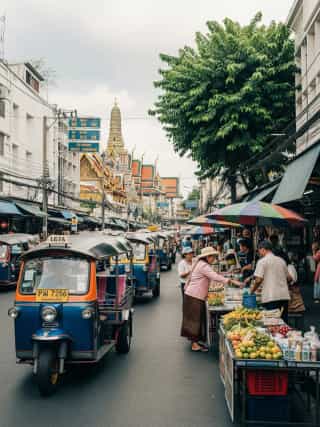
Bangkok - The Capital of Thailand
- Population
- 8,305,218
- Language
- Thai
- Continent
- Asia
- Since
- 1782
- Eco Ranking
- 91/195
Source: Environmental Performance Index 2024.
About Bangkok
Bangkok, officially Krung Thep Maha Nakhon in Thai, a name so long it was once listed in the Guinness World Records, has served as Thailand's capital since 1782, when King Rama I founded the Chakri dynasty and established the city on the eastern bank of the Chao Phraya River. The move from the short-lived capital of Thonburi was partly strategic: the river provided a natural defensive barrier against Burmese incursions. Throughout the 19th century, Bangkok was the seat from which Thai kings negotiated the country's survival between British and French colonial expansion, making it one of the few capitals in Southeast Asia never to fall under direct European colonial rule. Today, Bangkok houses the National Assembly, the Constitutional Court, and the offices of the prime minister, though the monarchy's official residence remains a central pillar of the city's political identity. Thailand has experienced over 13 military coups since 1932, several of which originated in Bangkok's military barracks. The full ceremonial name of the city, in Thai, is 168 characters long.
About Thailand
Thailand is a constitutional monarchy with a parliamentary system, though the military has repeatedly intervened in civilian governance since the abolition of absolute monarchy in 1932. The 2017 constitution, drafted under military rule, gave the armed forces significant structural influence over elected governments. Thailand's monarchy holds extraordinary legal protection under lèse-majesté laws, making it one of the most legally shielded royal institutions in the world.
View Bangkok on the map
Flight time from Bangkok to other capitals
| City | Distance (km) | Flight Time |
|---|---|---|
| Singapore | 1400 | 1h 39m |
| Tokyo | 4600 | 5h 25m |
| Abu Dhabi | 5000 | 5h 53m |
| Canberra | 7500 | 8h 49m |
| Rome | 8800 | 10h 21m |
| Paris | 9400 | 11h 4m |
| London | 9500 | 11h 11m |
| Cape Town | 10100 | 11h 53m |
| Washington, D.C. | 14200 | 16h 42m |
| Buenos Aires | 16900 | 19h 53m |
Capitals with similar population to Bangkok
Capitals with similar eco ranking to Bangkok
Source: Environmental Performance Index 2024.
Frequently Asked Questions
Why is Bangkok the capital of Thailand?
Bangkok became the capital in 1782 when King Rama I, founder of the Chakri dynasty, relocated the royal seat from Thonburi across the Chao Phraya River. The site was chosen for its defensibility and access to trade routes. It has remained the capital through every subsequent change of government.
What is Bangkok's official name?
Bangkok's official Thai name is Krung Thep Maha Nakhon, commonly shortened to Krung Thep. The full ceremonial name runs 168 characters and was once listed in the Guinness World Records as the world's longest place name.
Is Bangkok the largest city in Thailand?
Yes. Bangkok is by far the largest city in Thailand, with a population of over 8 million in the city proper and roughly 17 million in the wider metropolitan area. The second-largest city, Chiang Mai, has fewer than 200,000 people in its urban core, making Bangkok's dominance exceptionally pronounced even by regional standards.
Has Bangkok ever lost its capital status?
No. Bangkok has been the uninterrupted capital of Thailand since 1782. However, Thailand's government has periodically discussed relocating administrative functions to reduce pressure on the congested city, and a new government complex has been under development in the northern outskirts.
How many military coups has Thailand experienced since Bangkok became capital?
Thailand has experienced more than 13 successful military coups since 1932, when the absolute monarchy was overthrown. Several of these coups were staged in Bangkok, and the military has governed the country directly for significant periods, most recently following the 2014 coup led by General Prayuth Chan-ocha.
Sights and landmarks
Climate and best time to visit
Regional significance
Culture and customs