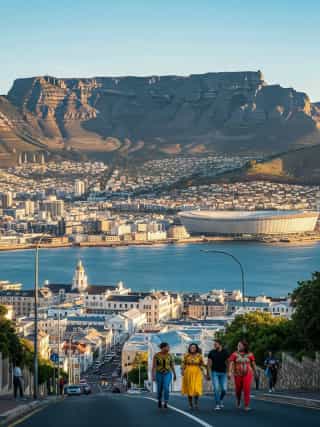
Cape Town - The Capital of South Africa
- Population
- 4,618,000
- Language
- Afrikaans
- Continent
- Africa
- Since
- 1910
- Eco Ranking
- 109/195
Source: Environmental Performance Index 2024.
About Cape Town
Cape Town is South Africa's legislative capital, the seat of the National Assembly and National Council of Provinces. South Africa operates under a three-capital arrangement: Pretoria serves as the executive capital (where the presidency and most national ministries are based), Bloemfontein as the judicial capital (seat of the Supreme Court of Appeal), and Cape Town as the legislative capital. This division is a direct legacy of the negotiations that created the Union of South Africa in 1910, balancing the interests of the former British colonies and Boer republics. The arrangement was retained through the apartheid era and the post-1994 democratic transition. Cape Town was originally established as a Dutch East India Company (VOC) supply station in 1652, making it the oldest European settlement in sub-Saharan Africa. It served as the administrative center of the Cape Colony under Dutch and then British rule. The Parliament of South Africa in Cape Town was the site of F.W. de Klerk's February 1990 speech announcing the unbanning of the ANC and the release of Nelson Mandela.
About South Africa
South Africa is a constitutional republic with a parliamentary system in which the president is elected by the National Assembly rather than directly by voters. The post-apartheid constitutional order, established in 1994 and finalized in the 1996 Constitution, created one of the world's most rights-protective legal frameworks. The African National Congress governed continuously from 1994 until losing its parliamentary majority in the May 2024 elections, after which it formed a Government of National Unity with multiple parties.
View Cape Town on the map
Flight time from Cape Town to other capitals
| City | Distance (km) | Flight Time |
|---|---|---|
| Buenos Aires | 6900 | 8h 7m |
| Abu Dhabi | 7500 | 8h 49m |
| Rome | 8500 | 10h 0m |
| Paris | 9300 | 10h 56m |
| London | 9700 | 11h 25m |
| Singapore | 9700 | 11h 25m |
| Canberra | 10800 | 12h 42m |
| Washington, D.C. | 12700 | 14h 56m |
| Tokyo | 14700 | 17h 18m |
Capitals with similar population to Cape Town
Capitals with similar eco ranking to Cape Town
Source: Environmental Performance Index 2024.
Frequently Asked Questions
Why does South Africa have three capitals?
The three-capital arrangement dates to the formation of the Union of South Africa in 1910, which united two British colonies (Cape Colony and Natal) and two former Boer republics (Transvaal and Orange Free State). Distributing capital functions among Cape Town, Pretoria, and Bloemfontein was a political compromise to balance the interests of these formerly separate entities.
What is Cape Town's specific role as a capital?
Cape Town is the legislative capital of South Africa, meaning the national Parliament, the National Assembly and the National Council of Provinces, sits there. The executive branch of government (the presidency and most ministries) operates from Pretoria, and the Supreme Court of Appeal is in Bloemfontein.
When did Cape Town become part of the South African capital structure?
Cape Town's role as legislative capital was established when the Union of South Africa was formed in 1910. Before that, it was the capital of the British Cape Colony. The arrangement has remained unchanged through the apartheid era and into the democratic period after 1994.
Is Cape Town the largest city in South Africa?
No. Johannesburg is South Africa's largest city by population. Cape Town is the second largest, with a metropolitan population of approximately 4.6 million. Pretoria (the executive capital) is part of the larger Tshwane metropolitan area.
What was the significance of the Cape Town Parliament in ending apartheid?
On 2 February 1990, President F.W. de Klerk delivered a speech in the Cape Town Parliament announcing the unbanning of the ANC, the Pan Africanist Congress, and the South African Communist Party, and committing to the release of Nelson Mandela. This speech marked the formal beginning of the transition away from apartheid.
Sights and landmarks
Climate and best time to visit
Economy