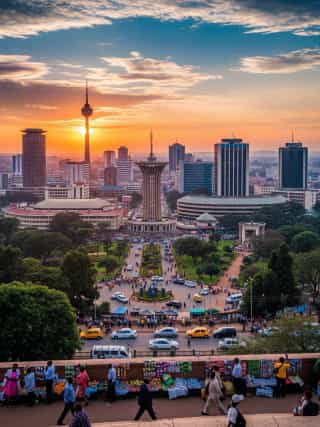
Nairobi - The Capital of Kenya
- Population
- 4,397,073
- Language
- Swahili
- Continent
- Africa
- Since
- 1963
- Eco Ranking
- 144/195
Source: Environmental Performance Index 2024.
About Nairobi
Nairobi was established in 1899 as a railway depot and supply camp during the construction of the Uganda Railway by British colonial authorities. It grew rapidly into a colonial administrative center and became the capital of the British East Africa Protectorate, and later of the Colony and Protectorate of Kenya. When Kenya gained independence on December 12, 1963, Nairobi became the capital of the new republic. The city was the scene of the 1952-1960 Mau Mau uprising, a major anti-colonial revolt against British rule that significantly shaped Kenya's path to independence. Nairobi is the headquarters of the United Nations Environment Programme (UNEP) and UN-Habitat, making it the only city in Africa, and in a developing country, to host two UN agency headquarters. The city houses Kenya's executive, legislative, and judicial institutions, and is the dominant economic center of East Africa. Nairobi has also experienced terrorist attacks, including the 1998 US Embassy bombing by Al-Qaeda, which killed 213 people, and the 2013 Westgate shopping mall attack by Al-Shabaab. Nairobi is the most economically significant city in East and Central Africa.
About Kenya
Kenya is a presidential republic. The 2010 constitution significantly restructured Kenyan governance, introducing a devolved system of 47 counties and expanding civil rights protections following the 2007-2008 post-election violence that killed over 1,000 people. Kenya has been governed by three presidents since multiparty elections were restored in 1991: Daniel arap Moi, Mwai Kibaki, Uhuru Kenyatta, and William Ruto (elected 2022). The country is a member of the African Union, the East African Community, and hosts major UN institutions. Nairobi functions as a regional hub for international organizations, NGOs, and multinational corporations operating across East Africa.
View Nairobi on the map
Flight time from Nairobi to other capitals
| City | Distance (km) | Flight Time |
|---|---|---|
| Abu Dhabi | 3400 | 4h 0m |
| Cape Town | 4100 | 4h 49m |
| Rome | 5400 | 6h 21m |
| Paris | 6500 | 7h 39m |
| London | 6800 | 8h 0m |
| Singapore | 7500 | 8h 49m |
| Buenos Aires | 10400 | 12h 14m |
| Tokyo | 11300 | 13h 18m |
| Canberra | 11900 | 14h 0m |
| Washington, D.C. | 12100 | 14h 14m |
Capitals with similar population to Nairobi
Capitals with similar eco ranking to Nairobi
| City | Eco Rank |
|---|---|
| Banjul | 143 |
| Accra | 144 |
| Maseru | 144 |
| Port Moresby | 144 |
| Nairobi | 144 |
| Conakry | 145 |
| Port-au-Prince | 146 |
Source: Environmental Performance Index 2024.
Frequently Asked Questions
Why did Nairobi become the capital of Kenya?
Nairobi grew from a railway depot established in 1899 into the main colonial administrative center of British East Africa. By the time of Kenya's independence in 1963, it was the largest and most developed city in the country, making it the natural choice for capital status.
When did Nairobi become the capital of Kenya?
Nairobi became the capital of independent Kenya on December 12, 1963, when Kenya gained independence from Britain. It had previously served as the capital of the British East Africa Protectorate and the Colony and Protectorate of Kenya.
Why are UN headquarters located in Nairobi?
The United Nations Environment Programme (UNEP) was established in Nairobi in 1972, following the Stockholm Conference on the Human Environment. UN-Habitat followed in 1978. Nairobi was selected in part due to Kenya's advocacy for locating UN institutions in developing countries. It remains the only African city to host UN agency headquarters.
What was the Mau Mau uprising and how did it affect Nairobi?
The Mau Mau uprising (1952-1960) was an armed revolt against British colonial rule in Kenya, led primarily by Kikuyu fighters. The British declared a state of emergency and conducted mass detentions, including in and around Nairobi. The uprising accelerated the political process toward Kenyan independence, which was achieved in 1963.
Is Nairobi the largest city in Kenya?
Yes. Nairobi is Kenya's largest city, with a population of approximately 4.4 million in the city proper and significantly more in the metropolitan area. It is also the largest city in East Africa and functions as the region's primary hub for finance, commerce, and international institutions.
Sights and landmarks
Climate and best time to visit
Regional significance