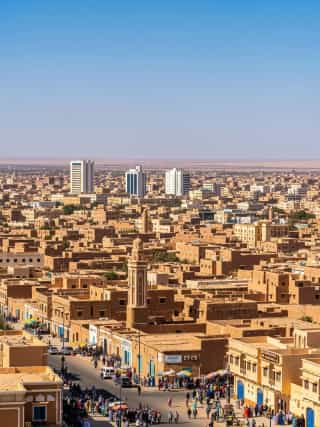
Nouakchott - The Capital of Mauritania
- Population
- 1,195,600
- Language
- Arabic
- Continent
- Africa
- Since
- 1960
- Eco Ranking
- 158/195
Source: Environmental Performance Index 2024.
About Nouakchott
Nouakchott is one of the youngest capital cities in the world, established virtually from scratch. Before 1957, the site was a small fishing village on the Atlantic coast of what was then French West Africa. When Mauritania prepared for independence, French and Mauritanian authorities selected the location as the site for a purpose-built capital, largely because it offered a coastal location roughly central between the country's north and south. At independence in 1960, Nouakchott had a population of only a few thousand. The city has since grown to over 1.2 million, a growth driven in part by severe droughts in the 1970s and 1980s that displaced nomadic populations into the capital. Mauritania abolished legal slavery in 1981, one of the last countries in the world to do so, but criminalized it only in 2007. Slavery and descent-based discrimination remain documented problems. Mauritania experienced coups in 2005 and 2008; General Mohamed Ould Abdel Aziz seized power in 2008 and later transitioned to civilian rule. Mauritania is the world's last country where slavery in practice, the ownership of people based on hereditary status, has been documented at scale by international human rights organizations.
About Mauritania
Mauritania is a presidential republic governed under an Islamic constitutional framework. President Mohamed Ould Ghazouani has governed since 2019 following elections that marked Mauritania's first peaceful democratic transfer of power. The country straddles the Arab Maghreb and sub-Saharan Africa, and its politics reflect tensions between Arab-Berber (Beidane) elites and Afro-Mauritanian populations (Haratine and sub-Saharan communities). Slavery and its legacy remain political and human rights issues. Mauritania is a member of the Arab League and the African Union. It has received Western counter-terrorism support for operations against groups linked to Al-Qaeda in the Islamic Maghreb (AQIM).
View Nouakchott on the map
Flight time from Nouakchott to other capitals
| City | Distance (km) | Flight Time |
|---|---|---|
| Paris | 3800 | 4h 28m |
| Rome | 3800 | 4h 28m |
| London | 4000 | 4h 42m |
| Washington, D.C. | 6300 | 7h 25m |
| Cape Town | 6800 | 8h 0m |
| Abu Dhabi | 7200 | 8h 28m |
| Buenos Aires | 7400 | 8h 42m |
| Singapore | 13100 | 15h 25m |
| Tokyo | 13500 | 15h 53m |
| Canberra | 17600 | 20h 42m |
Capitals with similar population to Nouakchott
Capitals with similar eco ranking to Nouakchott
Source: Environmental Performance Index 2024.
Frequently Asked Questions
Why was Nouakchott built as a new capital?
Nouakchott was chosen as Mauritania's capital in 1957 because no existing city was large enough or suitably located to serve as a national capital. The site was selected for its coastal position, roughly midway along the country's length. Construction of the capital city began from essentially nothing in the years before independence in 1960.
When did Nouakchott become the capital of Mauritania?
Nouakchott became the capital of the Islamic Republic of Mauritania on November 28, 1960, when Mauritania gained independence from France. The city had been under construction since 1957 and had a very small population at the time of independence.
When did Mauritania abolish slavery?
Mauritania officially abolished slavery in 1981, becoming one of the last countries in the world to do so. However, it did not criminalize the practice until 2007. Despite the legal prohibition, international human rights organizations including the Global Slavery Index continue to document hereditary slavery, the ownership of people based on their ancestors' slave status, as an ongoing problem in Mauritania.
Has Mauritania experienced military coups?
Yes. Mauritania experienced coups in 1978, 1980, 1984, 2005, and 2008. The 2008 coup brought General Mohamed Ould Abdel Aziz to power. He later won elections in 2009 and 2014 and stepped down in 2019 after constitutional term limits were enforced, an unusual outcome in the region. He was subsequently arrested on corruption charges in 2021.
Is Nouakchott the largest city in Mauritania?
Yes. Nouakchott is by far the largest city in Mauritania, home to approximately a third of the country's total population of around 4.5 million. The city's rapid growth, from a few thousand at independence in 1960 to over 1.2 million today, was driven by rural-urban migration and displacement caused by droughts.
Sights and landmarks
Climate and best time to visit
Economy