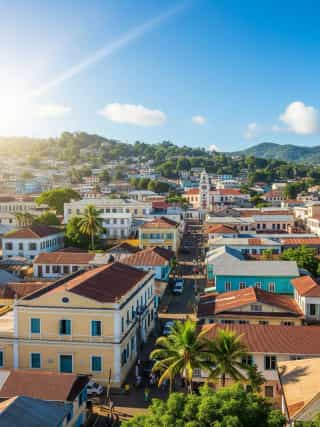
São Tomé - The Capital of São Tomé and Príncipe
- Population
- 80,000
- Language
- Portuguese
- Continent
- Africa
- Since
- 1485
- Eco Ranking
- 148/195
Source: Environmental Performance Index 2024.
About São Tomé
São Tomé, the capital of São Tomé and Príncipe, sits on São Tomé Island, the larger of the country's two main islands. The city was founded by Portuguese explorers in 1485 on land that was uninhabited before their arrival, there is no pre-colonial indigenous population in the country's recorded history. São Tomé became a major transit point for the Atlantic slave trade, serving as a hub for enslaved Africans transported to Brazil and the Caribbean. The country gained independence from Portugal on 12 July 1975. São Tomé and Príncipe was one of the first African countries to undertake a democratic transition, moving from a single-party Marxist state to a multiparty democracy in 1990. The country operates a semi-presidential system, with the president and prime minister sharing executive authority. São Tomé is a small city of around 80,000 people housing the National Assembly, the presidency, and the principal ministries of one of Africa's smallest and least populous states.
About São Tomé and Príncipe
São Tomé and Príncipe is a semi-presidential republic consisting of two main islands in the Gulf of Guinea. It is one of Africa's smallest states by both area and population. The country transitioned to multiparty democracy in 1990 and has maintained democratic governance since. Its economy has historically been based on cocoa; offshore oil was discovered but has not yet been developed at scale.
View São Tomé on the map
Flight time from São Tomé to other capitals
| City | Distance (km) | Flight Time |
|---|---|---|
| Cape Town | 4000 | 4h 42m |
| Rome | 4700 | 5h 32m |
| Paris | 5400 | 6h 21m |
| London | 5700 | 6h 42m |
| Abu Dhabi | 5800 | 6h 49m |
| Buenos Aires | 7800 | 9h 11m |
| Washington, D.C. | 9400 | 11h 4m |
| Singapore | 10800 | 12h 42m |
| Tokyo | 13700 | 16h 7m |
| Canberra | 14500 | 17h 4m |
Capitals with similar population to São Tomé
| City | Population |
|---|---|
| Bandar Seri Begawan | 100,700 |
| Mbabane | 94,874 |
| Honiara | 84,520 |
| São Tomé | 80,000 |
| South Tarawa | 63,439 |
| Moroni | 62,100 |
| Port Vila | 51,437 |
Capitals with similar eco ranking to São Tomé
| City | Eco Rank |
|---|---|
| Conakry | 145 |
| Port-au-Prince | 146 |
| Addis Ababa | 147 |
| São Tomé | 148 |
| N'Djamena | 149 |
| Kampala | 150 |
| Lomé | 151 |
Source: Environmental Performance Index 2024.
Frequently Asked Questions
Was São Tomé and Príncipe always inhabited?
No. The islands of São Tomé and Príncipe were uninhabited when Portuguese explorers arrived around 1470. There was no indigenous population prior to Portuguese colonisation. The population today is descended from Portuguese colonisers and the enslaved Africans brought to work on sugar plantations, creating a distinct Creole culture and language (Forro).
When did São Tomé and Príncipe gain independence?
São Tomé and Príncipe gained independence from Portugal on 12 July 1975, following Portugal's Carnation Revolution of April 1974, which ended decades of authoritarian rule and began the decolonisation of Portugal's African territories. The country was initially governed as a one-party state by the MLSTP (Liberation Movement of São Tomé and Príncipe).
What type of government does São Tomé and Príncipe have?
São Tomé and Príncipe is a semi-presidential republic, meaning executive power is shared between a directly elected president and a prime minister accountable to the National Assembly. The country transitioned from a Marxist single-party state to a multiparty democratic system in 1990, making it one of Africa's earliest democratic transitions.
What role did São Tomé play in the slave trade?
São Tomé was a central node in the Atlantic slave trade from the late 15th through the 17th centuries. Portuguese colonisers used the island as a transit and processing point for enslaved Africans transported from the West African coast to Portugal, Brazil, and the Caribbean. The island's sugar plantations were among the first in the Atlantic world to use enslaved African labour at scale.
Is São Tomé and Príncipe one of Africa's smallest countries?
Yes. São Tomé and Príncipe is Africa's second smallest country by population, after Seychelles, with approximately 220,000 inhabitants. By area, at 964 square kilometres, it is Africa's second smallest country, also after Seychelles. It is a member of the African Union, the Community of Portuguese Language Countries (CPLP), and the Economic Community of Central African States (ECCAS).
Sights and landmarks
Climate and best time to visit
Regional significance
Economy