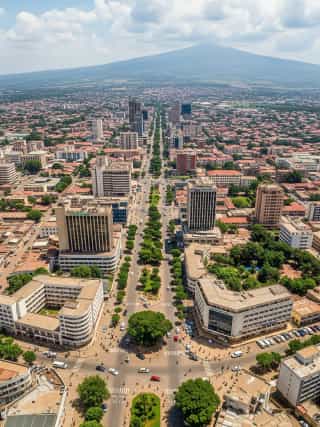
Yaoundé - The Capital of Cameroon
- Population
- 4,164,296
- Language
- French
- Continent
- Africa
- Since
- 1889
- Eco Ranking
- 135/195
Source: Environmental Performance Index 2024.
About Yaoundé
Yaoundé was established as a German military and research post in 1889, during the colonial scramble for Central Africa that followed the Berlin Conference. After Germany's defeat in World War I, Cameroon was partitioned between France and Britain under League of Nations mandates, and Yaoundé became the administrative capital of French Cameroun. When Cameroon gained independence on 1 January 1960, Yaoundé retained its capital status. In 1961, the southern part of British Cameroons voted to join the Republic of Cameroon in a plebiscite, creating a federal republic, later reorganised into a unitary state in 1972. Yaoundé is the seat of all three branches of the Cameroonian government. Paul Biya, who has governed Cameroon since 1982, is one of the longest-serving heads of state in the world. His administration has been characterised by centralised control and allegations of electoral manipulation. Since 2017, a separatist conflict has been ongoing in the predominantly English-speaking Northwest and Southwest regions, collectively known as Ambazonia, where armed groups are fighting for independence. The crisis has displaced hundreds of thousands. Cameroon is often described as "Africa in miniature" for the geographic and ecological variety contained within its borders.
About Cameroon
Cameroon is a presidential republic in Central Africa. The president holds dominant executive authority, and the country's political system has been characterised by centralised power under Paul Biya since 1982. The National Assembly and Senate sit in Yaoundé. Cameroon has a dual official-language system, French and English, reflecting its colonial history. The Anglophone separatist conflict in the country's northwest and southwest has been one of the most significant political crises in the country's postcolonial history.
View Yaoundé on the map
Flight time from Yaoundé to other capitals
| City | Distance (km) | Flight Time |
|---|---|---|
| Rome | 4200 | 4h 56m |
| Cape Town | 4300 | 5h 4m |
| Paris | 5100 | 6h 0m |
| Abu Dhabi | 5100 | 6h 0m |
| London | 5400 | 6h 21m |
| Buenos Aires | 8400 | 9h 53m |
| Washington, D.C. | 9600 | 11h 18m |
| Singapore | 10300 | 12h 7m |
| Tokyo | 13100 | 15h 25m |
| Canberra | 14400 | 16h 56m |
Capitals with similar population to Yaoundé
Capitals with similar eco ranking to Yaoundé
Source: Environmental Performance Index 2024.
Frequently Asked Questions
Why is Yaoundé the capital of Cameroon?
Yaoundé became the capital because it served as the administrative center of French Cameroun during the colonial period, a role it inherited from German administration. When Cameroon gained independence in 1960, Yaoundé retained its position as the seat of government.
How long has Paul Biya governed Cameroon?
Paul Biya has governed Cameroon since 6 November 1982, making him one of the longest-serving heads of state in the world. He became prime minister in 1975 and succeeded President Ahmadou Ahidjo as president. As of 2025, he has been in power for over 42 years.
What is the Anglophone crisis in Cameroon?
The Anglophone crisis refers to an armed separatist conflict that began in 2017 in Cameroon's English-speaking Northwest and Southwest regions. Anglophone groups, marginalised within the French-dominated state, initially protested peacefully but the movement escalated into an insurgency. Armed factions declared an independent state called Ambazonia, and the conflict has killed thousands and displaced over 700,000 people.
Was Cameroon ever under British rule?
Yes. After World War I, the former German Kamerun colony was partitioned between France and Britain under League of Nations mandates. The French territory became independent in 1960, and in 1961 a UN plebiscite gave British Southern Cameroons the choice to join Nigeria or the Republic of Cameroon. It chose union with Cameroon, creating the bilingual federal state.
Is Yaoundé the largest city in Cameroon?
No. Douala, Cameroon's main port and economic hub, is the largest city with a population estimated at over 3.5 million. Yaoundé, the political capital, has a population of around 4 million in its broader metropolitan area but is generally considered slightly smaller than Douala in economic terms. Both cities have grown rapidly in recent decades.
Sights and landmarks
Climate and best time to visit
Economy