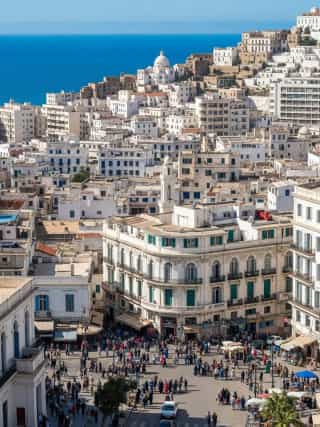
Algiers - The Capital of Algeria
- Population
- 2,364,230
- Language
- Arabic
- Continent
- Africa
- Since
- 944
- Eco Ranking
- 114/195
Source: Environmental Performance Index 2024.
About Algiers
Algiers has functioned as a major political center since the Berber city of Icosium was established on its site in antiquity, with continuous habitation confirmed through the Roman, Vandal, Byzantine, and Arab periods. The modern city's political history intensified under the Ottoman Empire, when Algiers became the capital of the Regency of Algiers in the 16th century, a semi-autonomous Ottoman province governed by a series of deys. France invaded in 1830 and established Algiers as the administrative center of French Algeria, reshaping the city's architecture and demographics. The Algerian War of Independence (1954-1962), fought partly in Algiers itself, particularly during the Battle of Algiers (1956-1957), ended with independence on 5 July 1962. The city became the capital of the People's Democratic Republic of Algeria under the National Liberation Front (FLN), which maintained a single-party state until 1989. Algeria's political system remains dominated by the military establishment and the FLN. The Presidential Palace and both chambers of Parliament are located in Algiers.
About Algeria
Algeria is a unitary semi-presidential republic in which the military establishment exercises substantial informal authority over civilian governance. The President is elected by popular vote and holds broad executive powers; the Parliament is bicameral. Algeria is Africa's largest country by land area. The FLN, which led the independence struggle, has dominated Algerian politics since 1962, though the country formally introduced multiparty elections in 1989 following mass protests.
View Algiers on the map
Flight time from Algiers to other capitals
| City | Distance (km) | Flight Time |
|---|---|---|
| Rome | 1000 | 1h 11m |
| Paris | 1400 | 1h 39m |
| London | 1700 | 2h 0m |
| Abu Dhabi | 5000 | 5h 53m |
| Washington, D.C. | 6800 | 8h 0m |
| Cape Town | 8000 | 9h 25m |
| Buenos Aires | 10200 | 12h 0m |
| Tokyo | 10800 | 12h 42m |
| Singapore | 10900 | 12h 49m |
| Canberra | 17000 | 20h 0m |
Capitals with similar population to Algiers
Capitals with similar eco ranking to Algiers
| City | Eco Rank |
|---|---|
| Honiara | 111 |
| Ouagadougou | 111 |
| Bissau | 112 |
| Tehran | 114 |
| Algiers | 114 |
| Ciudad de la Paz | 115 |
| Brazzaville | 116 |
Source: Environmental Performance Index 2024.
Frequently Asked Questions
How long has Algiers been a capital city?
Algiers has served as a major seat of political authority since at least the 10th century, when Berber rulers established control over the site. It became the capital of the Ottoman Regency of Algiers in the 16th century, and has continuously functioned as the primary seat of government in the region through French colonial rule and into independence in 1962.
What was the Battle of Algiers?
The Battle of Algiers (1956-1957) was a campaign by the French military to suppress the FLN independence movement in the capital. French paratroopers used systematic torture and mass detention to dismantle FLN networks in the city. The battle is considered a pivotal and controversial episode of the independence war, later depicted in Gillo Pontecorvo's 1966 film of the same name.
When did Algiers become the capital of independent Algeria?
Algeria gained independence from France on 5 July 1962, and Algiers immediately became the capital of the new republic. The National Liberation Front (FLN) established a single-party government with Algiers as its seat, a dominance it maintained until multiparty reforms in 1989.
Is Algiers the largest city in Algeria?
Yes. Algiers is the largest city in Algeria, with a population of approximately 2.4 million in the city proper and over 4 million in the greater metropolitan area. It is the country's dominant center of government, finance, and media.
Who governs from Algiers today?
Algeria's president governs from Algiers, currently President Abdelmadjid Tebboune, elected in 2019 and re-elected in 2024. The two chambers of Parliament, the People's National Assembly and the Council of the Nation, also sit in Algiers, though political analysts note significant military influence over formal civilian institutions.
Sights and landmarks
Climate and best time to visit
Economy