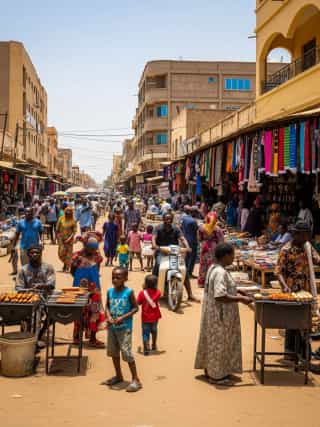
Bamako - The Capital of Mali
- Population
- 2,446,800
- Language
- French
- Continent
- Africa
- Since
- 1960
- Eco Ranking
- 159/195
Source: Environmental Performance Index 2024.
About Bamako
Bamako became the capital of the French Soudan (French Sudan) colonial territory in 1908, having grown from a small fishing and trading settlement on the Niger River into an administrative hub following the French conquest of the region in the 1880s. When the Republic of Mali gained independence on 22 September 1960, initially as part of a brief federation with Senegal that dissolved almost immediately, Bamako became the capital of the new state. Mali's post-independence political history has been marked by recurring military coups. The country's first president, Modibo Keïta, was overthrown by a military coup in 1968. Subsequent democratic openings have been interrupted by further coups in 1991, 2012, and twice in 2020-2021. The most recent coup in 2021 installed the current transitional military government led by Colonel Assimi Goïta. Bamako hosts the National Assembly (currently suspended), the transitional government's executive bodies, and the Supreme Court. Mali's security crisis, driven by jihadist insurgencies in the north and center of the country, has been a dominant factor in the political instability that led to the recent coups. The capital itself has experienced terrorist attacks targeting government and international targets.
About Mali
Mali is currently governed by a military transitional government following coups in August 2020 and May 2021. Constitutional governance has been suspended. Colonel Assimi Goïta serves as transitional president. Mali has experienced significant jihadist insurgency since 2012, following a Tuareg rebellion and coup that destabilized the north of the country. The transitional government expelled French forces in 2022 and has since contracted Russian Wagner Group mercenaries for security support.
View Bamako on the map
Flight time from Bamako to other capitals
| City | Distance (km) | Flight Time |
|---|---|---|
| Rome | 3800 | 4h 28m |
| Paris | 4100 | 4h 49m |
| London | 4400 | 5h 11m |
| Cape Town | 5900 | 6h 56m |
| Abu Dhabi | 6700 | 7h 53m |
| Washington, D.C. | 7300 | 8h 35m |
| Buenos Aires | 7500 | 8h 49m |
| Singapore | 12300 | 14h 28m |
| Tokyo | 13700 | 16h 7m |
| Canberra | 16600 | 19h 32m |
Capitals with similar population to Bamako
Capitals with similar eco ranking to Bamako
Source: Environmental Performance Index 2024.
Frequently Asked Questions
When did Bamako become the capital of Mali?
Bamako became the capital of independent Mali on 22 September 1960, when the Mali Federation (briefly joined with Senegal) dissolved and the Republic of Mali was proclaimed. Bamako had previously served as the capital of French Sudan, the colonial territory, from 1908.
How many coups has Mali experienced?
Mali has experienced multiple military coups since independence. Major coups occurred in 1968 (against Modibo Keïta), 1991 (which opened a democratic transition), 2012 (following military setbacks against Tuareg rebels), August 2020, and May 2021. The last two coups were carried out by the same military officers.
Is Bamako the largest city in Mali?
Yes. Bamako is the largest city in Mali by far, with a population that has grown to approximately 2.5 million. It is one of the fastest-growing cities in Africa, having expanded rapidly from a small colonial administrative post. No other Malian city approaches it in size or governmental importance.
What is the current political situation in Mali?
Since the 2021 coup, Mali has been governed by a military transitional government led by Colonel Assimi Goïta. The National Assembly is suspended and the constitution has been replaced by a transitional charter. Elections have been repeatedly postponed. The government has expelled French military forces and turned to Russian security contractors (Wagner Group) for support against jihadist insurgencies.
Why is Mali experiencing ongoing instability?
Mali's instability is rooted in a 2012 crisis in which Tuareg rebels and jihadist groups seized the north of the country, and a coup ousted the government. Though French intervention in 2013 (Operation Serval) pushed back the insurgency, jihadist groups affiliated with al-Qaeda and the Islamic State have continued to expand. Governance failures, ethnic tensions, and economic marginalization of northern regions have fueled the crisis.
Sights and landmarks
Climate and best time to visit
Regional significance
Economy