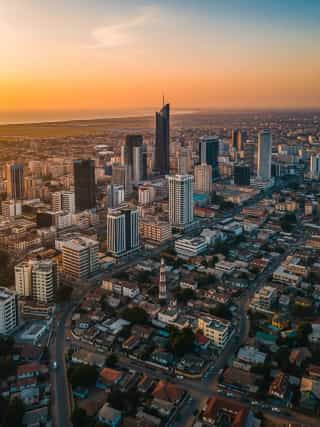
Accra - The Capital of Ghana
- Population
- 2,291,352
- Language
- English
- Continent
- Africa
- Since
- 1877
- Eco Ranking
- 144/195
Source: Environmental Performance Index 2024.
About Accra
Accra has served as the administrative center of present-day Ghana since 1877, when the British colonial administration transferred its Gold Coast headquarters from Cape Coast. The city's coastal position made it strategically valuable to British commercial and military interests. After independence on 6 March 1957, Ghana becoming the first sub-Saharan African country to gain independence from European colonial rule, Accra became the capital of the new republic under President Kwame Nkrumah. Nkrumah's government made Accra a symbolic center of pan-African political thought, hosting the 1958 All-African Peoples' Conference, which drew independence movements from across the continent. The city houses the Parliament of Ghana, the Supreme Court, and the Jubilee House (formerly Flagstaff House), the official seat of the presidency. Ghana's political system has transitioned between civilian and military governments multiple times since independence, but has maintained uninterrupted democratic governance since 1993. Accra generates an estimated 25% of Ghana's GDP, concentrating both political and economic power.
About Ghana
Ghana is a unitary presidential republic with a single-chamber Parliament. It is widely regarded as one of West Africa's most stable democracies, having conducted multiple peaceful transfers of power since returning to multiparty democracy in 1993. Ghana was the first sub-Saharan African country to gain independence from British colonial rule. The country operates under its 1992 constitution, which imposes a two-term presidential limit.
View Accra on the map
Flight time from Accra to other capitals
| City | Distance (km) | Flight Time |
|---|---|---|
| Rome | 4200 | 4h 56m |
| Paris | 4800 | 5h 39m |
| Cape Town | 4800 | 5h 39m |
| London | 5100 | 6h 0m |
| Abu Dhabi | 6200 | 7h 18m |
| Buenos Aires | 7600 | 8h 56m |
| Washington, D.C. | 8500 | 10h 0m |
| Singapore | 11500 | 13h 32m |
| Tokyo | 13800 | 16h 14m |
| Canberra | 15500 | 18h 14m |
Capitals with similar population to Accra
Capitals with similar eco ranking to Accra
| City | Eco Rank |
|---|---|
| Banjul | 143 |
| Maseru | 144 |
| Nairobi | 144 |
| Port Moresby | 144 |
| Accra | 144 |
| Conakry | 145 |
| Port-au-Prince | 146 |
Source: Environmental Performance Index 2024.
Frequently Asked Questions
When did Accra become the capital of Ghana?
Accra became the capital of the British Gold Coast colony in 1877, replacing Cape Coast. It retained this status when Ghana declared independence on 6 March 1957, becoming the capital of Africa's first independent sub-Saharan republic.
Why was Accra chosen as the capital of Ghana?
The British selected Accra as the colonial administrative capital primarily due to its coastal location and the presence of Fort Christiansborg (now Jubilee House), which had served European traders and colonial administrators since the 17th century. Its infrastructure and administrative institutions were already established by independence.
Is Accra the largest city in Ghana?
Yes. Accra is both the capital and the largest city in Ghana, with a metropolitan population of approximately 4 million people. It is the country's primary center of government, commerce, and media.
What is the seat of government in Accra?
The seat of the Ghanaian presidency is Jubilee House, formerly known as Flagstaff House, located in the Cantonments area of Accra. The Parliament of Ghana and the Supreme Court are also based in Accra.
What was Accra's political significance during the pan-African movement?
Under President Kwame Nkrumah, Accra became a hub of pan-African politics. In 1958 it hosted the All-African Peoples' Conference, gathering independence movements from across the continent. Nkrumah envisioned Accra as the symbolic capital of a future United States of Africa.
Sights and landmarks
Climate and best time to visit
Culture and customs
Economy