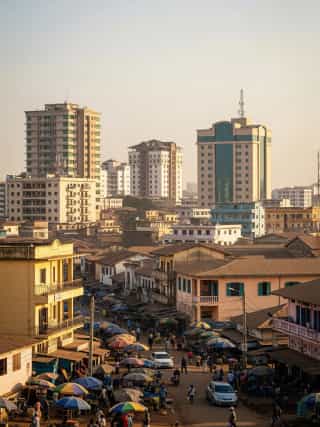
Conakry - The Capital of Guinea
- Population
- 1,667,864
- Language
- French
- Continent
- Africa
- Since
- 1885
- Eco Ranking
- 145/195
Source: Environmental Performance Index 2024.
About Conakry
Conakry was founded by France in 1885 on Tombo Island in the Gulf of Guinea, and connected to the mainland by a causeway. It became the administrative capital of French Guinea, a territory France formally established in 1891. Guinea was the only French West African colony to vote against joining the French Community in the 1958 referendum, a decision that prompted France to withdraw all administrative personnel and resources within months, leaving Guinea and its capital to build state institutions largely from scratch. Sékou Touré, Guinea's first president, ruled from Conakry in an authoritarian manner until his death in 1984. The capital has since been the site of successive coups: a military takeover followed Touré's death, and most recently, a coup in September 2021 ousted President Alpha Condé following his controversial third-term bid. Conakry houses the presidency, the transitional government, and major state institutions. Guinea holds the world's largest known reserves of bauxite, making Conakry a node in global aluminum supply chains despite persistent political instability.
About Guinea
Guinea is currently governed by a military junta, the Rassemblement des Forces Patriotiques, which took power in September 2021. The transitional government suspended the constitution and dissolved state institutions following the coup. Guinea is one of the world's leading bauxite producers and holds significant reserves of iron ore, gold, and diamonds, yet remains among the poorest countries in West Africa. The Economic Community of West African States (ECOWAS) has applied pressure for a return to civilian rule.
View Conakry on the map
Flight time from Conakry to other capitals
| City | Distance (km) | Flight Time |
|---|---|---|
| Rome | 4400 | 5h 11m |
| Paris | 4600 | 5h 25m |
| London | 4800 | 5h 39m |
| Cape Town | 5900 | 6h 56m |
| Buenos Aires | 6800 | 8h 0m |
| Washington, D.C. | 7000 | 8h 14m |
| Abu Dhabi | 7400 | 8h 42m |
| Singapore | 13000 | 15h 18m |
| Tokyo | 14300 | 16h 49m |
| Canberra | 16700 | 19h 39m |
Capitals with similar population to Conakry
Capitals with similar eco ranking to Conakry
| City | Eco Rank |
|---|---|
| Accra | 144 |
| Maseru | 144 |
| Nairobi | 144 |
| Port Moresby | 144 |
| Conakry | 145 |
| Port-au-Prince | 146 |
| Addis Ababa | 147 |
Source: Environmental Performance Index 2024.
Frequently Asked Questions
Why did Guinea vote 'no' in the 1958 French referendum?
In the 1958 referendum on the French Fifth Republic's constitution, Guinea under Sékou Touré was the only French African colony to reject membership in the proposed French Community, effectively choosing immediate independence over continued association with France. France retaliated by withdrawing its personnel and resources, cutting off Guinea abruptly.
When did Conakry become the capital of an independent Guinea?
Conakry became the capital of independent Guinea on 2 October 1958, when Guinea declared independence from France following the referendum result. Sékou Touré became the country's first president and ruled until his death in 1984.
What happened in Guinea's 2021 coup?
On 5 September 2021, military officers led by Colonel Mamadi Doumbouya seized power in Conakry, capturing President Alpha Condé. Condé had provoked widespread protests by amending the constitution in 2020 to allow himself a third term. The coup brought a military junta to power and suspended the constitution.
Is Conakry the largest city in Guinea?
Yes, Conakry is by far the largest city in Guinea, with a population of approximately 1.7 million. It accounts for a dominant share of Guinea's urban population and economic activity, despite its location on a narrow island peninsula connected to the mainland.
Why is Guinea geopolitically significant despite its instability?
Guinea holds the world's largest known reserves of bauxite, the primary ore used to produce aluminum, and significant deposits of iron ore, gold, and diamonds. This resource wealth makes it strategically important to global commodity markets, attracting investment from China, Russia, and Western companies even during periods of political instability.
Sights and landmarks
Climate and best time to visit
Regional significance
Economy