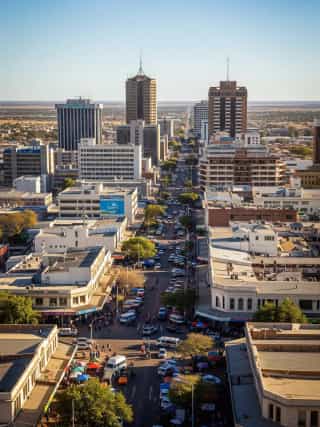
Gaborone - The Capital of Botswana
- Population
- 246,325
- Language
- Tswana
- Continent
- Africa
- Since
- 1966
- Eco Ranking
- 70/195
Source: Environmental Performance Index 2024.
About Gaborone
Gaborone was purpose-built to serve as the capital of newly independent Botswana in 1966, when the country gained independence from Britain. Before independence, the territory, then called the Bechuanaland Protectorate, was administered from Mafikeng, a town located across the border in what is now South Africa. The decision to construct an entirely new capital reflected the practical reality that no existing town in Bechuanaland was adequate to house a national government. Construction of the city began in 1964, just two years before independence, making it one of the fastest purpose-built capitals in African history. The site was chosen largely because of its position near the rail line and its proximity to water sources. Today, Gaborone houses the National Assembly, the offices of the presidency, and the bulk of Botswana's civil service. Botswana has maintained an unbroken record of multiparty elections since independence, making Gaborone one of the most politically stable capitals on the African continent. It is the smallest national capital in southern Africa by population.
About Botswana
Botswana is a landlocked republic in southern Africa governed under a parliamentary democracy. The president serves as both head of state and head of government, elected indirectly by the National Assembly. Since independence in 1966, power has transferred peacefully through elections, a record rare in the region. Botswana transformed from one of the world's poorest countries at independence into an upper-middle-income economy, largely through revenues from diamond mining managed through a state partnership with De Beers.
View Gaborone on the map
Flight time from Gaborone to other capitals
| City | Distance (km) | Flight Time |
|---|---|---|
| Cape Town | 1300 | 1h 32m |
| Abu Dhabi | 6300 | 7h 25m |
| Rome | 7500 | 8h 49m |
| Buenos Aires | 8000 | 9h 25m |
| Paris | 8500 | 10h 0m |
| London | 8800 | 10h 21m |
| Singapore | 8800 | 10h 21m |
| Canberra | 11100 | 13h 4m |
| Washington, D.C. | 12800 | 15h 4m |
| Tokyo | 13600 | 16h 0m |
Capitals with similar population to Gaborone
| City | Population |
|---|---|
| Dili | 277,279 |
| Nassau | 274,400 |
| Porto-Novo | 264,320 |
| Gaborone | 246,325 |
| Paramaribo | 240,924 |
| Malé | 227,486 |
| Wellington | 215,800 |
Capitals with similar eco ranking to Gaborone
| City | Eco Rank |
|---|---|
| Bogotá | 67 |
| Santiago | 68 |
| Roseau | 69 |
| Gaborone | 70 |
| Georgetown | 71 |
| Kingston | 73 |
| Bandar Seri Begawan | 74 |
Source: Environmental Performance Index 2024.
Frequently Asked Questions
Why was Gaborone built as a new city?
When Botswana became independent in 1966, the former colonial capital, Mafikeng, was located in South Africa, making it unusable as the capital of a new sovereign state. No existing settlement in Bechuanaland was large enough to house a national government, so a new city was constructed from scratch beginning in 1964.
When did Gaborone become the capital of Botswana?
Gaborone officially became the capital on September 30, 1966, when Botswana achieved independence from Britain. The city had been under construction since 1964 in anticipation of this date.
Is Gaborone the largest city in Botswana?
Yes, Gaborone is the largest city in Botswana, though its population of around 246,000 makes it one of the smaller national capitals in Africa. The city has grown rapidly since independence but remains modest in size compared to other regional capitals.
Where was Botswana governed from before Gaborone?
During the colonial period, the Bechuanaland Protectorate was administered from Mafikeng (then spelled Mafeking), a town in present-day South Africa. This unusual arrangement meant the colonial government operated entirely outside the territory it governed.
What government institutions are based in Gaborone?
Gaborone hosts the National Assembly of Botswana, the Office of the President, the High Court, and the headquarters of all major government ministries. The city is the complete administrative, legislative, and judicial center of the country.
Sights and landmarks
Climate and best time to visit
Regional significance
Economy