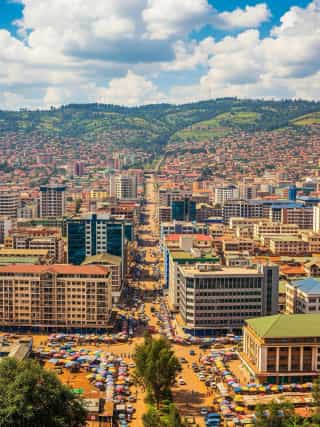
Kigali - The Capital of Rwanda
- Population
- 1,132,686
- Language
- Kinyarwanda
- Continent
- Africa
- Since
- 1962
- Eco Ranking
- 163/195
Source: Environmental Performance Index 2024.
About Kigali
Kigali became the capital of independent Rwanda on July 1, 1962, when the country gained independence from Belgian colonial administration. Located in the geographic center of the country, it was a small administrative town of limited size at independence and grew considerably in subsequent decades. Kigali is indelibly associated with the 1994 Rwandan genocide, in which approximately 800,000 people, primarily Tutsi, as well as Hutu who opposed the extremist government, were killed in roughly 100 days between April and July. The genocide was carried out largely by Hutu extremist militias known as the Interahamwe, incited by radio broadcasts on Radio Mille Collines, and took place throughout Rwanda with particular intensity in Kigali. The Rwandan Patriotic Front, a Tutsi-led rebel movement, captured Kigali in July 1994, ending the genocide. Since then, Rwanda has undertaken an extensive national reconstruction under President Paul Kagame, who has governed since 2000. Kigali has been transformed into one of Africa's most orderly and carefully administered cities, frequently cited for cleanliness, low corruption, and urban planning. Rwanda banned plastic bags in 2008, one of the earliest and most comprehensive such bans in the world, and Kigali is the administrative center of this national governance model. Kagame's government, while credited with economic development, is also criticized for political repression and restrictions on opposition.
About Rwanda
Rwanda is a presidential republic in Central Africa that gained independence from Belgium in 1962. The country experienced a genocide in 1994 that killed approximately 800,000 people. Under President Paul Kagame, who has governed since 2000, Rwanda has undergone significant economic development and is frequently cited as one of Africa's best-governed states. However, Kagame's government has been criticized for suppressing political opposition, restricting press freedom, and conducting operations against dissidents abroad. Rwanda has a constitutional ban on ethnically-based political parties.
View Kigali on the map
Flight time from Kigali to other capitals
| City | Distance (km) | Flight Time |
|---|---|---|
| Cape Town | 3800 | 4h 28m |
| Abu Dhabi | 4000 | 4h 42m |
| Rome | 5200 | 6h 7m |
| Paris | 6200 | 7h 18m |
| London | 6600 | 7h 46m |
| Singapore | 8200 | 9h 39m |
| Buenos Aires | 9700 | 11h 25m |
| Washington, D.C. | 11600 | 13h 39m |
| Tokyo | 11900 | 14h 0m |
| Canberra | 12500 | 14h 42m |
Capitals with similar population to Kigali
Capitals with similar eco ranking to Kigali
Source: Environmental Performance Index 2024.
Frequently Asked Questions
What role did Kigali play in the 1994 genocide?
Kigali was the epicenter of the 1994 Rwandan genocide. The mass killings began in the capital on April 6, 1994, following the shooting down of President Habyarimana's plane. Government and military forces, along with Interahamwe militias, carried out organized killings throughout the city. The UN peacekeeping mission present in Kigali was ordered not to intervene. The Rwandan Patriotic Front captured the city in July 1994, ending the genocide.
When did Kigali become the capital of Rwanda?
Kigali became the capital of independent Rwanda on July 1, 1962, when the country gained independence from Belgium, which had administered Rwanda as a League of Nations mandate and later UN Trust Territory since 1916.
How has Kigali changed since the 1994 genocide?
Kigali has been extensively rebuilt and reorganized since 1994 under President Paul Kagame's government. The city is now frequently cited as one of Africa's cleanest, safest, and most efficiently governed capitals. Major infrastructure investments, strict urban planning regulations, and anti-corruption measures have transformed it significantly from the devastated city of 1994.
Is Paul Kagame's government in Kigali democratic?
Rwanda holds elections, but Kagame's government is widely criticized by international human rights organizations for suppressing political opposition, restricting press freedom, and eliminating meaningful electoral competition. Kagame won the 2017 presidential election with over 98% of the vote after a constitutional amendment allowed him to stand for additional terms.
Is Kigali the largest city in Rwanda?
Yes, Kigali is by far the largest city in Rwanda, with a population of approximately 1.1 million. It is significantly larger than any other Rwandan city and serves as the country's economic, political, and administrative center.
Sights and landmarks
Climate and best time to visit
Culture and customs
Economy