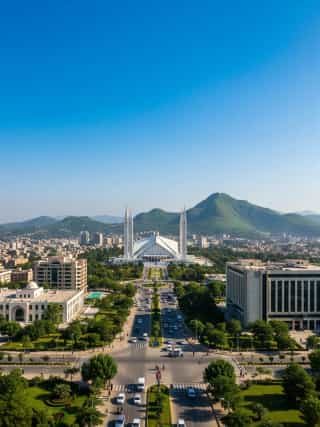
Islamabad - The Capital of Pakistan
- Population
- 1,095,064
- Language
- Urdu
- Continent
- Asia
- Since
- 1967
- Eco Ranking
- 179/195
Source: Environmental Performance Index 2024.
About Islamabad
Islamabad is a purpose-built capital, constructed from scratch in the early 1960s to replace Karachi as Pakistan's seat of government. The decision to build a new capital was driven by several factors: Karachi, located on the southern coast, was considered strategically vulnerable and too distant from the country's northern population centers; there were also political concerns about the dominance of Karachi's Sindhi and Muhajir populations over national governance. Construction began in 1961 under a master plan developed by Greek architect Constantinos Doxiadis, and the government formally relocated to Islamabad in 1967. The city was positioned on the Pothohar Plateau near the older city of Rawalpindi, which served as a transitional administrative base during construction. Islamabad houses the Parliament of Pakistan, the Supreme Court, the presidency, and the Prime Minister's Secretariat. Pakistan has experienced repeated interruptions of civilian rule: the military has governed directly for roughly half of the country's existence since independence in 1947, and military influence over civilian governments has remained a persistent feature of Pakistani politics. Karachi, with a population exceeding 14 million, remains vastly larger than Islamabad and continues to dominate Pakistan's economy, illustrating the sharp distinction between political and economic capital in the country.
About Pakistan
Pakistan is a federal parliamentary republic consisting of four provinces plus federally administered territories. It gained independence from British India in 1947 as an Islamic republic. The military has played an outsized role in Pakistani politics, governing directly for approximately half the country's post-independence history and exerting sustained influence during civilian governments. Pakistan has fought three major wars with India, and the disputed territory of Kashmir remains a source of ongoing tension. The country possesses nuclear weapons.
View Islamabad on the map
Flight time from Islamabad to other capitals
| City | Distance (km) | Flight Time |
|---|---|---|
| Abu Dhabi | 2100 | 2h 28m |
| Singapore | 4800 | 5h 39m |
| Rome | 5300 | 6h 14m |
| Paris | 5900 | 6h 56m |
| London | 6000 | 7h 4m |
| Tokyo | 6000 | 7h 4m |
| Cape Town | 9400 | 11h 4m |
| Canberra | 11000 | 12h 56m |
| Washington, D.C. | 11400 | 13h 25m |
| Buenos Aires | 15600 | 18h 21m |
Capitals with similar population to Islamabad
Capitals with similar eco ranking to Islamabad
Source: Environmental Performance Index 2024.
Frequently Asked Questions
Why did Pakistan build a new capital instead of keeping Karachi?
Pakistan relocated its capital from Karachi to purpose-built Islamabad for strategic, political, and geographic reasons. Karachi was considered vulnerable to naval attack, too distant from the northern population centers, and associated with specific ethnic constituencies. A central capital was intended to project national unity across Pakistan's diverse regions.
When did Islamabad become the capital of Pakistan?
Construction of Islamabad began in 1961, and the government formally transferred from Karachi to Islamabad in 1967. The nearby city of Rawalpindi served as the interim seat of government during the construction period.
Is Islamabad the largest city in Pakistan?
No. Islamabad is one of Pakistan's smaller major cities. Karachi, the former capital, has a population exceeding 14 million and is Pakistan's largest city and primary economic center. Lahore is also considerably larger than Islamabad.
What is the role of the military in Pakistani governance from Islamabad?
The Pakistani military has governed the country directly through multiple coup periods, under Ayub Khan, Yahya Khan, Zia ul-Haq, and Pervez Musharraf, totaling approximately half of Pakistan's post-independence history. Even during civilian governments, the military's headquarters in Rawalpindi (adjacent to Islamabad) has exercised significant political influence.
Who designed Islamabad?
Islamabad was planned by Greek architect and urban planner Constantinos Doxiadis, who developed a master plan for the city beginning in 1960. The plan used a grid-based sector system that continues to define the city's layout today.
Sights and landmarks
Climate and best time to visit
Regional significance
Culture and customs