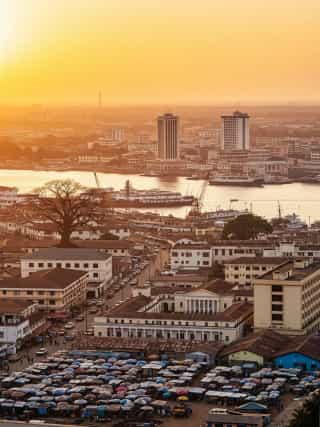
Freetown - The Capital of Sierra Leone
- Population
- 1,136,000
- Language
- English
- Continent
- Africa
- Since
- 1792
- Eco Ranking
- 128/195
Source: Environmental Performance Index 2024.
About Freetown
Freetown was established in 1787 by British abolitionists and the Sierra Leone Company as a settlement for freed Black loyalists from North America, Black poor from London, and later liberated Africans rescued from slave ships. The name directly reflects the founding purpose. Britain formally made Sierra Leone a Crown Colony in 1808, with Freetown as its capital. The colony was used by the Royal Navy as a base for the West Africa Squadron, which intercepted slave ships after Britain abolished the slave trade in 1807, liberated Africans were landed at Freetown, where many settled and formed the Krio (Creole) community. Sierra Leone gained independence in 1961, and Freetown became the capital of the independent state. The country experienced a devastating civil war from 1991 to 2002, in which the Revolutionary United Front (RUF) committed systematic atrocities including mass amputations. Freetown suffered a particularly brutal attack in January 1999 when RUF forces entered the city, killing thousands of civilians. A UN-backed Special Court for Sierra Leone subsequently prosecuted war crimes committed during this period. Freetown houses the parliament, the presidency, and all central government institutions.
About Sierra Leone
Sierra Leone is a presidential republic that has maintained multiparty democracy since the end of the civil war in 2002. Power has transferred peacefully between the two main parties, the Sierra Leone People's Party (SLPP) and the All People's Congress (APC). The country remains one of the poorest in the world despite significant mineral resources including diamonds, iron ore, and rutile. The 2014-2016 Ebola epidemic severely damaged the health system and economy, with Freetown as a major affected area.
View Freetown on the map
Flight time from Freetown to other capitals
| City | Distance (km) | Flight Time |
|---|---|---|
| Rome | 4500 | 5h 18m |
| Paris | 4700 | 5h 32m |
| London | 4900 | 5h 46m |
| Cape Town | 5800 | 6h 49m |
| Buenos Aires | 6700 | 7h 53m |
| Washington, D.C. | 7200 | 8h 28m |
| Abu Dhabi | 7400 | 8h 42m |
| Singapore | 13000 | 15h 18m |
| Tokyo | 14300 | 16h 49m |
| Canberra | 16500 | 19h 25m |
Capitals with similar population to Freetown
Capitals with similar eco ranking to Freetown
Source: Environmental Performance Index 2024.
Frequently Asked Questions
Why was Freetown founded and what does its name mean?
Freetown was founded in 1787 as a settlement for freed slaves and Black poor, organized by British abolitionists. The name literally reflects its founding purpose as a town for free people. The British government and the Sierra Leone Company provided land and initial support for the settlement.
When did Freetown become the capital of an independent state?
Freetown became the capital of independent Sierra Leone on 27 April 1961, when the country gained independence from Britain. Before that, it had been the capital of the British Crown Colony of Sierra Leone since 1808.
What happened in Freetown during the Sierra Leone civil war?
During the civil war (1991-2002), Freetown was attacked in January 1999 by forces of the Revolutionary United Front in an operation called 'Operation No Living Thing.' Thousands of civilians were killed and many more suffered amputations in a campaign of deliberate brutality. The attack prompted greater international involvement, including the deployment of British troops and the expansion of the UN peacekeeping mission.
Who were the Krio people of Sierra Leone?
The Krio (or Creole) people are descended from freed slaves, Black loyalists from North America, and Africans liberated from slave ships who were settled in Freetown from the late 18th century onward. They developed a distinct language (Krio, which became Sierra Leone's lingua franca) and culture, and held significant social and political influence during the colonial period.
Is Freetown the largest city in Sierra Leone?
Yes, Freetown is the largest city in Sierra Leone, with a population of approximately 1.1 million. It is located on a peninsula on the Atlantic coast and is home to the country's main port, which handles the majority of Sierra Leone's international trade.
Sights and landmarks
Climate and best time to visit
Economy