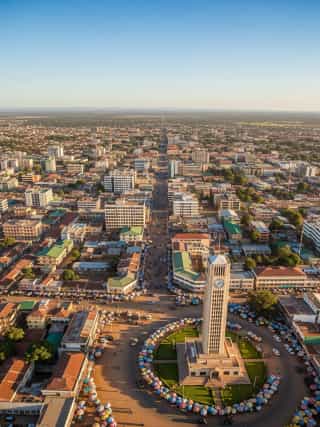
Dodoma - The Capital of Tanzania
- Population
- 410,956
- Language
- Swahili
- Continent
- Africa
- Since
- 1973
- Eco Ranking
- 104/195
Source: Environmental Performance Index 2024.
About Dodoma
Dodoma presents a textbook case of a designated capital that has never fully displaced its predecessor. Tanzania's parliament declared Dodoma the official capital in 1973, motivated by a desire to shift political and economic activity away from the coastal city of Dar es Salaam and toward the interior, following a model similar to Brazil's transfer to Brasília. The government began relocating ministries and institutions over subsequent decades, and the National Assembly officially moved to Dodoma. However, Dar es Salaam on the coast has remained the country's largest city, commercial center, and the location where most government ministries and diplomatic missions continue to operate. The presidency relocated to Dodoma under President John Magufuli, who moved there as a visible symbol of the commitment to the capital designation. Dodoma is located in the center of the country, making it more geographically accessible to the population than the coastal Dar es Salaam. The city sits at 1,120 meters elevation in a semi-arid plateau. As of the mid-2020s, the capital transfer remains incomplete, and Tanzania functionally operates with a split capital arrangement.
About Tanzania
Tanzania is a presidential republic formed in 1964 by the union of Tanganyika and the islands of Zanzibar, which retains semi-autonomous status. The ruling Chama Cha Mapinduzi (CCM) party has governed continuously since independence and is one of Africa's longest-ruling parties. Tanzania's political system has been characterized by dominant-party rule, though competitive elections have been held. Zanzibar maintains its own president, government, and legislature for internal affairs, while the union parliament in Dodoma handles federal matters.
View Dodoma on the map
Flight time from Dodoma to other capitals
| City | Distance (km) | Flight Time |
|---|---|---|
| Cape Town | 3600 | 4h 14m |
| Abu Dhabi | 4000 | 4h 42m |
| Rome | 5800 | 6h 49m |
| Paris | 6900 | 8h 7m |
| London | 7300 | 8h 35m |
| Singapore | 7600 | 8h 56m |
| Buenos Aires | 10000 | 11h 46m |
| Tokyo | 11700 | 13h 46m |
| Canberra | 11700 | 13h 46m |
| Washington, D.C. | 12400 | 14h 35m |
Capitals with similar population to Dodoma
Capitals with similar eco ranking to Dodoma
Source: Environmental Performance Index 2024.
Frequently Asked Questions
Why was Dodoma chosen as Tanzania's capital instead of Dar es Salaam?
Dodoma was selected as capital in 1973 to shift political activity away from the coastal, commercially dominant Dar es Salaam and toward Tanzania's interior. The move was also ideologically motivated by President Julius Nyerere's Ujamaa socialist philosophy, which emphasized rural development and reducing inequality between coastal and interior regions.
Is Dodoma actually functioning as Tanzania's capital?
Partially. The National Assembly and the presidency are based in Dodoma, and it is the official capital. However, most government ministries, foreign embassies, and major commercial institutions remain in Dar es Salaam, meaning Tanzania effectively functions with a split capital arrangement more than five decades after the Dodoma designation.
Is Dodoma the largest city in Tanzania?
No. Dar es Salaam is Tanzania's largest city by a large margin, with a metropolitan population of over 7 million. Dodoma has approximately 411,000 residents. This disparity is one reason the capital transfer has been difficult to complete.
When did the National Assembly move to Dodoma?
The Tanzanian National Assembly officially moved to Dodoma in the 1990s, though the process was gradual. The parliament building in Dodoma became the formal legislative seat. The executive branch under President Magufuli also explicitly moved presidential operations to Dodoma in the mid-2010s to reinforce the capital's status.
What is Zanzibar's political relationship with mainland Tanzania?
Zanzibar is a semi-autonomous archipelago that joined Tanganyika in 1964 to form Tanzania. It maintains its own president, Revolutionary Council, and House of Representatives for internal governance. However, Zanzibar sends representatives to the union parliament in Dodoma and Zanzibaris hold Tanzanian nationality. The terms of the union and Zanzibar's degree of autonomy have been a recurring source of political tension.
Sights and landmarks
Climate and best time to visit
Regional significance
Economy