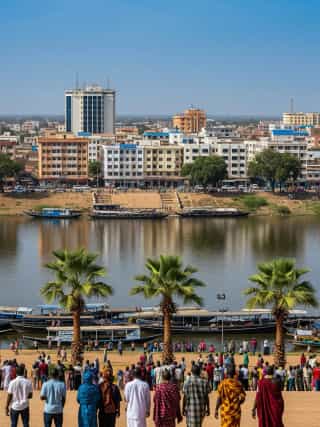
Juba - The Capital of South Sudan
- Population
- 525,953
- Language
- English
- Continent
- Africa
- Since
- 2011
- Eco Ranking
- -
Source: Environmental Performance Index 2024.
About Juba
Juba became the capital of South Sudan on July 9, 2011, when the country became the world's newest internationally recognized state following a referendum in which 98.8% of South Sudanese voted for independence from Sudan. The referendum was a key provision of the 2005 Comprehensive Peace Agreement that ended Sudan's second civil war. Juba had served as the administrative headquarters of Equatoria Province under British colonial rule and later under Sudanese administration. The early years of South Sudan's independence were marked by significant optimism and substantial international investment, including major foreign aid and reconstruction efforts. However, in December 2013, political conflict between President Salva Kiir and former Vice President Riek Machar erupted into a devastating civil war along ethnic lines, primarily between the Dinka and Nuer communities. The civil war caused the displacement of millions of people and severely damaged Juba's infrastructure. A peace agreement was signed in 2018 and a unity government formed in 2020, but stability has remained fragile. Juba houses the Transitional National Legislature and the offices of the Presidency. The city has grown rapidly, from a small town to a capital of over 500,000, but basic services including reliable electricity, water, and sanitation remain severely limited. South Sudan is one of the world's most oil-dependent economies, with petroleum revenues constituting the vast majority of government income.
About South Sudan
South Sudan is a presidential republic that became the world's newest country on July 9, 2011, following secession from Sudan. It is one of the least developed countries in the world, with widespread poverty, limited infrastructure, and a population severely affected by conflict. A civil war from 2013 to 2018 caused hundreds of thousands of deaths and displaced over 4 million people. The country is heavily dependent on oil revenues, most of which flow through pipelines to Sudan for export. Governance has been characterized by ethnic tensions and factional conflict.
View Juba on the map
Flight time from Juba to other capitals
| City | Distance (km) | Flight Time |
|---|---|---|
| Abu Dhabi | 3300 | 3h 53m |
| Cape Town | 4500 | 5h 18m |
| Rome | 4500 | 5h 18m |
| Paris | 5600 | 6h 35m |
| London | 6000 | 7h 4m |
| Singapore | 8000 | 9h 25m |
| Buenos Aires | 10300 | 12h 7m |
| Washington, D.C. | 11300 | 13h 18m |
| Tokyo | 11300 | 13h 18m |
| Canberra | 12800 | 15h 4m |
Capitals with similar population to Juba
Frequently Asked Questions
When did Juba become the capital of South Sudan?
Juba became the capital of South Sudan on July 9, 2011, when South Sudan declared independence from Sudan following a January 2011 referendum in which 98.8% of voters chose separation. South Sudan was immediately recognized by Sudan and subsequently by most of the international community.
Why did South Sudan secede from Sudan?
South Sudan's predominantly Christian and animist population in the south had experienced decades of political marginalization and armed conflict with the Arab Muslim-dominated northern government. Two civil wars, from 1955 to 1972 and 1983 to 2005, resulted in millions of deaths. The 2005 Comprehensive Peace Agreement provided for a referendum on independence, which produced an overwhelming vote for secession.
What caused South Sudan's civil war?
Civil war broke out in December 2013 when forces loyal to President Salva Kiir (of the Dinka ethnic group) clashed with forces loyal to former Vice President Riek Machar (of the Nuer ethnic group). The conflict rapidly became an ethnically driven civil war causing hundreds of thousands of deaths and displacing more than 4 million people.
Is Juba a developed city?
No. Juba transitioned rapidly from a small provincial town to a national capital with very limited infrastructure. Basic services including reliable electricity, clean water, and sanitation are not consistently available. The civil war significantly damaged development, and Juba remains one of the least developed capitals in the world.
What is South Sudan's main source of government revenue?
South Sudan is one of the world's most oil-dependent states, with petroleum revenues constituting approximately 90% of government income. However, most oil infrastructure is in the south while the only export pipelines run through Sudan, creating a significant political and economic dependency on relations with its northern neighbor.
Sights and landmarks
Climate and best time to visit
Economy