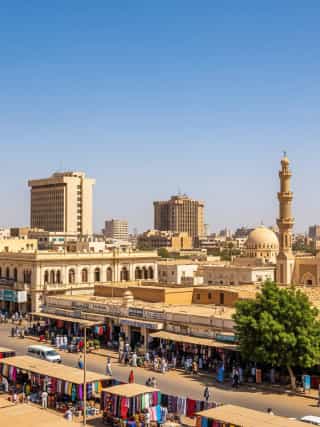
Khartoum - The Capital of Sudan
- Population
- 5,274,321
- Language
- Arabic
- Continent
- Africa
- Since
- 1956
- Eco Ranking
- 131/195
Source: Environmental Performance Index 2024.
About Khartoum
Khartoum occupies a strategically significant position at the confluence of the Blue Nile and the White Nile, where the two tributaries merge to form the Nile. The city was founded as an Egyptian military outpost in 1824 and became the seat of Egyptian and later British colonial administration over the Sudan. It is notably the site of the 1885 siege in which Mahdist forces killed the British General Charles Gordon, a moment that had significant political consequences in Britain. Sudan achieved independence from joint British-Egyptian rule on January 1, 1956, with Khartoum as its capital. The country subsequently endured two prolonged civil wars between its predominantly Arab Muslim north and its more diverse southern regions. In 2011, Sudan's southern region seceded to form South Sudan following a referendum, and Khartoum became the capital of a reduced Sudanese state. Long governed under President Omar al-Bashir, who was indicted by the International Criminal Court for genocide and crimes against humanity, Sudan underwent a popular uprising in 2019 that led to Bashir's overthrow. A transitional government was established but was itself overthrown in a military coup in 2021. In April 2023, fighting erupted in Khartoum between the Sudanese Armed Forces and the paramilitary Rapid Support Forces, causing massive destruction in the city, the displacement of millions, and what the UN described as one of the world's worst humanitarian crises.
About Sudan
Sudan is a republic in northeastern Africa whose government has been in acute conflict since April 2023, when war broke out between the Sudanese Armed Forces and the Rapid Support Forces paramilitary group. The country experienced decades of authoritarian rule under Omar al-Bashir, who was removed in 2019. A transitional civilian-military council was overthrown in a 2021 military coup. Sudan lost its southern region when South Sudan gained independence in 2011. The country holds significant Nile water rights and occupies a strategic position in northeastern Africa.
View Khartoum on the map
Flight time from Khartoum to other capitals
| City | Distance (km) | Flight Time |
|---|---|---|
| Abu Dhabi | 2500 | 2h 56m |
| Rome | 3500 | 4h 7m |
| Paris | 4600 | 5h 25m |
| London | 4900 | 5h 46m |
| Cape Town | 5700 | 6h 42m |
| Singapore | 8000 | 9h 25m |
| Washington, D.C. | 10500 | 12h 21m |
| Tokyo | 10500 | 12h 21m |
| Buenos Aires | 11100 | 13h 4m |
| Canberra | 13400 | 15h 46m |
Capitals with similar population to Khartoum
Capitals with similar eco ranking to Khartoum
Source: Environmental Performance Index 2024.
Frequently Asked Questions
Why is Khartoum located at the confluence of the Nile?
Khartoum was established at the confluence of the Blue Nile and White Nile as an Egyptian military outpost in 1824, chosen for its strategic position controlling access to both river systems. The site offered both defensive advantages and logistical benefits for controlling river-borne trade and movement throughout the Sudan.
When did Khartoum become the capital of independent Sudan?
Khartoum became the capital of independent Sudan on January 1, 1956, when Sudan achieved independence from joint British-Egyptian condominium rule. It had previously served as the administrative capital of Anglo-Egyptian Sudan.
What happened to Khartoum in 2023?
In April 2023, fighting broke out in Khartoum between the Sudanese Armed Forces (SAF) and the Rapid Support Forces (RSF), a powerful paramilitary group. The urban warfare caused massive destruction of the city's infrastructure, displaced millions of residents, and created a humanitarian catastrophe described by the UN as one of the worst in the world.
How did South Sudan's independence affect Khartoum?
When South Sudan gained independence in 2011, Sudan lost approximately one-third of its territory and the majority of its oil reserves, which were located in the south. Khartoum remained the capital of the reduced Sudanese state, but the country's fiscal situation deteriorated sharply as oil revenues declined dramatically.
Who was Omar al-Bashir and what happened to him?
Omar al-Bashir governed Sudan from Khartoum for 30 years following his 1989 coup. He was indicted by the International Criminal Court in 2009 and 2010 for genocide, war crimes, and crimes against humanity related to the Darfur conflict. He was overthrown by the military in April 2019 following mass popular protests and was subsequently arrested by Sudanese authorities.
Sights and landmarks
Climate and best time to visit
Regional significance
Culture and customs