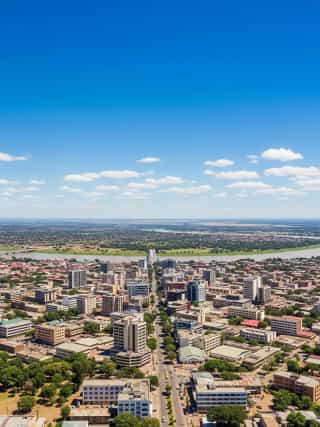
Lilongwe - The Capital of Malawi
- Population
- 1,122,000
- Language
- English
- Continent
- Africa
- Since
- 1975
- Eco Ranking
- 156/195
Source: Environmental Performance Index 2024.
About Lilongwe
Lilongwe replaced Zomba as the capital of Malawi in 1975, a decision made by President Hastings Kamuzu Banda, who had governed the country since independence from Britain in 1964. Banda ruled as president-for-life and consolidated authority around his own person and party, the Malawi Congress Party. The choice of Lilongwe, a more centrally located city in the country's Central Region, was partly strategic, intended to reduce the historical dominance of the Southern Region where Zomba was located. South Africa provided financial assistance for the construction of the new capital, a relationship that reflected Banda's controversial willingness to maintain ties with the apartheid government at a time when most African states refused contact. The capital's development was gradual; government offices transferred progressively through the late 1970s and 1980s. In 1994, Malawi transitioned from single-party rule to multiparty democracy following a referendum, and Banda lost the subsequent election, one of the cleaner political transitions of the 1990s African democratization wave. Today, Lilongwe is the seat of the National Assembly, the presidency, and the main government ministries. Malawi remains one of the least urbanized and poorest countries in the world.
About Malawi
Malawi is a landlocked republic in southeastern Africa, bordered by Tanzania, Mozambique, and Zambia. It gained independence from Britain on 6 July 1964. After Banda's one-party rule ended in 1994, Malawi has held regular multiparty elections. The country has experienced significant political volatility, including the 2020 annulment of the presidential election by the Constitutional Court, a rare instance of a successfully judicially reversed election in Africa. Malawi is among the world's lowest-income countries, with an economy heavily dependent on agriculture.
View Lilongwe on the map
Flight time from Lilongwe to other capitals
| City | Distance (km) | Flight Time |
|---|---|---|
| Cape Town | 2700 | 3h 11m |
| Abu Dhabi | 4800 | 5h 39m |
| Rome | 6600 | 7h 46m |
| Paris | 7600 | 8h 56m |
| Singapore | 7900 | 9h 18m |
| London | 8000 | 9h 25m |
| Buenos Aires | 9300 | 10h 56m |
| Canberra | 11300 | 13h 18m |
| Tokyo | 12300 | 14h 28m |
| Washington, D.C. | 12800 | 15h 4m |
Capitals with similar population to Lilongwe
Capitals with similar eco ranking to Lilongwe
Source: Environmental Performance Index 2024.
Frequently Asked Questions
Why did Malawi move its capital from Zomba to Lilongwe?
President Hastings Kamuzu Banda initiated the move in 1975, citing Lilongwe's more central geographic location within Malawi as a key reason. The decision also had political dimensions, reducing the historical importance of the Southern Region. Construction of the new capital was partly financed by South Africa, reflecting Banda's controversial ties with the apartheid government.
When did Lilongwe become the capital of Malawi?
Lilongwe officially became the capital of Malawi in 1975, replacing Zomba, which had served as the seat of government since the British colonial period. The transition of government departments was gradual and extended through the late 1970s and into the 1980s.
Who was Hastings Kamuzu Banda and how did he govern from Lilongwe?
Hastings Kamuzu Banda led Malawi from independence in 1964 until 1994. He declared himself president-for-life in 1971, banned opposition parties, and maintained a cult of personality throughout his rule. He governed from Lilongwe after the capital transfer in 1975. International pressure and a 1993 referendum forced him to accept multiparty elections in 1994, which he lost.
Is Lilongwe the largest city in Malawi?
Yes, Lilongwe is the largest city in Malawi with a population of approximately 1.1 million. It surpassed Blantyre, the country's commercial center, in population as the capital developed. Blantyre remains the main commercial hub, creating a functional division between political and economic activity.
How did Malawi transition to democracy?
Malawi held a referendum on multiparty democracy in June 1993, in which voters overwhelmingly backed the end of one-party rule. Presidential and parliamentary elections in May 1994 were won by Bakili Muluzi of the United Democratic Front, ending Banda's 30-year rule. International observers considered the elections broadly credible, making Malawi an early example of African democratic transition.
Sights and landmarks
Climate and best time to visit
Economy